Starting a trade business in Australia: the setup checklist
To start a trade business in Australia: get your licence, register an ABN, choose a structure, get insurance, open a business bank account, set your prices and sort your quoting and invoicing. Rules differ by state and trade, so check your licensing body and an accountant.
Going out on your own is exciting and a little overwhelming. Work through these steps in order and you will cover the essentials.
- Get your ABN free through the official site.
- Sort licence, insurance and a business account.
- Decide about GST and tax early.
Your checklist
Set up checklist for a new trade business
0 of 8 done. Your ticks stay on this device.
ABN
An ABN is free to apply for through the Australian Business Register. Be careful of sites that charge for it.
Licences and insurance
Most trades need a licence from the state or territory regulator. Public liability insurance is not always a legal requirement, but many customers and builders insist on it.
Money basics
- Open a separate business account.
- Decide about GST early.
- Set aside tax from day one.
Pricing and paperwork
Set your rate (see the hourly rate guide), then set up a quote template and invoice template so every job looks professional.
Tip. Get an accountant early. The first-year setup is where small mistakes get expensive.
Your first month
- Get your ABN and licence sorted.
- Book public liability insurance and any other cover your trade needs.
- Open the business bank account.
- Set your hourly rate and a short price list.
- Create quote and invoice templates.
- Claim your Google Business Profile and ask your first customers for reviews.
Mistakes to avoid
- Underpricing to win work and then being unable to keep going.
- Mixing personal and business money.
- Putting off tax until the bill arrives.
- Working without written quotes or terms.
Choosing a structure
There is no single right answer. A short chat with an accountant at the start is usually worth the cost.
| Structure | Good for | Watch out for |
|---|---|---|
| Sole trader | Starting out, simplest | You are personally responsible for debts. |
| Company | Growing or higher-risk work | More setup and ongoing costs. |
| Partnership | Two or more owners | You can be liable for partner's decisions. |
| Trust | Specific tax and asset planning | Complex, get advice. |
Your first 30 days
- Week 1: legal setupLicence, ABN, structure, insurance.
- Week 2: money setupBank account, GST decision, accounting method.
- Week 3: pricing and paperworkHourly rate, quote and invoice templates, terms.
- Week 4: get foundGoogle profile, photos, reviews and word of mouth.
- ReviewWhat is working? What is missing?
Mistakes new tradies make
- Under-pricing to win work and never recovering.
- Not separating business and personal money.
- Skipping insurance or licences.
- Forgetting to set money aside for GST and tax.
- Leaving invoicing until the weekend.
- Not asking for reviews from early customers.
Tip. Read our guides on your hourly rate and GST registration before your first quote.
A short budget for month one
Prices vary by trade and state, so get quotes before you commit.
| Item | What to plan for |
|---|---|
| Licence and qualifications | Fees set by your state licensing body. |
| Insurance | Public liability and tools, quoted by brokers. |
| Tools and vehicle | Only what you need for your first jobs. |
| Software and phone | Quoting, invoicing and a business number. |
| Marketing | Free basics first: Google profile and reviews. |
| Cash buffer | A few weeks of living costs while you wait for payments. |
A real-life scenario
A new carpenter set up with a licence, an ABN, public liability insurance and a basic toolkit, then spent his first weekend on his Google profile and a simple one-page site. He asked his first five customers for reviews and used a template for quotes and tax invoices. Three months later, most of his work came through word of mouth and Google.
A solid start is not about spending big. It is about getting the legal basics right and building a habit of asking.
Quick answers
Do I need a company?
Not necessarily. Many tradies start as sole traders. An accountant can advise.
How much does an ABN cost?
Applying through the official ABR site is free.
Do I need an ABN to start as a tradie?
In most cases yes. You need an ABN to invoice businesses and to register for GST. Check the ABR.
Should I be a sole trader or a company?
Sole trader is the simplest start. Ask an accountant about your situation as you grow.
What insurance do tradies need?
Public liability is common, plus tool, vehicle and income cover as you grow. Your trade licence may have requirements.
When should I register for GST?
When your turnover reaches $75,000, or earlier if it suits you. See our GST registration guide.
Share this infographic
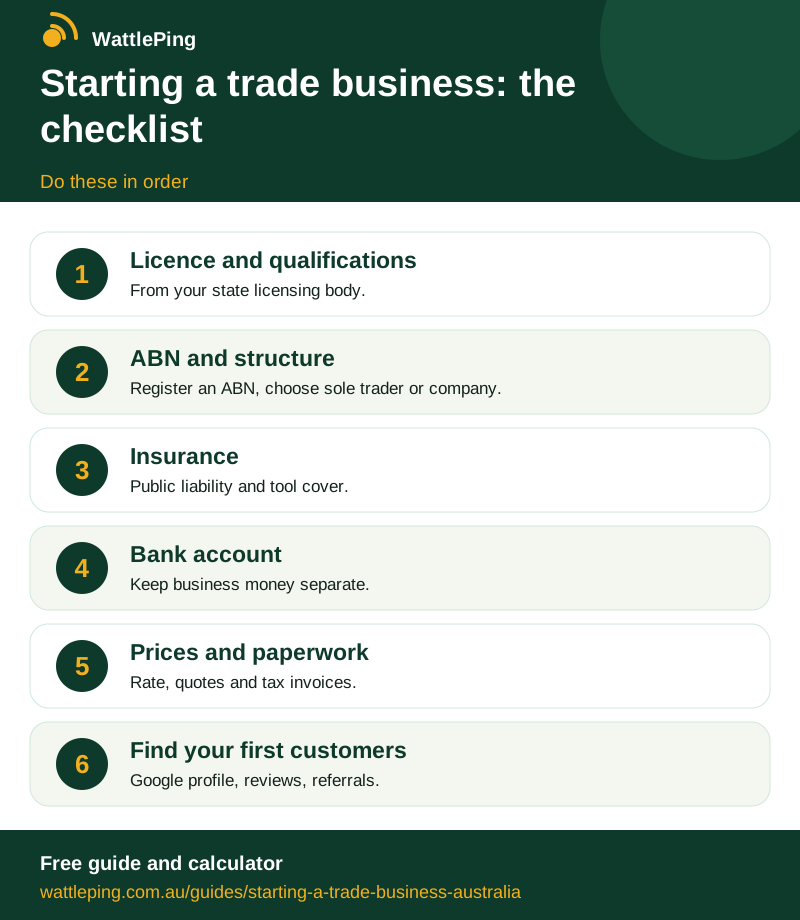
Free to share with a link back. Copy the code below to embed it on your site.
CopiedSources and further reading
This guide is general information, not legal, tax or financial advice. Rules change and differ by state, so check with the ATO, your state regulator or your accountant before you act.
Keep reading
More in Running the business: Job costing: did that job actually make money? · How many jobs do you need to break even? · A weekly admin routine that takes under an hour · How to choose quoting and invoicing software for your trade · Paying super for your employees, simply explained. All guides, WattlePing features, pricing.