How to calculate your hourly rate as a tradie
Your hourly rate is your yearly target income plus your yearly business costs, divided by the number of hours you can realistically bill. Most tradies bill far fewer hours than they work, so the rate has to be higher than it feels.
Charging what your mates charge is not a pricing strategy. The right rate is a sum, and the answer is often higher than people expect because so much of your week is not billable. Driving, quoting, ordering, admin and chasing payments are all work you do not get paid for directly. This guide shows you how to build the number from the ground up.
- Start with the income you want, then add your running costs.
- Divide by billable hours, not total hours. They are very different.
- Add a profit margin on top.
- Review your rate every year.
Why a rate based on wages falls short
Many tradies start by asking what a wage would be and charge a bit more. That misses most of what the business costs to run. An employee gets paid leave, super, tools, a vehicle and someone else chasing payments. When you work for yourself, all of that has to come out of your rate.
The five steps
- Pick your target incomeHow much you want to take home after business costs.
- Add tax and superAllow for income tax, and your own super if you are saving for retirement.
- Add business costsVehicle, fuel, tools, insurance, phone, software, licences, accounting, marketing.
- Estimate billable hoursCount weeks worked, then subtract leave, sick days, public holidays and unbillable time.
- Divide, then add profitRequired income divided by billable hours, plus a profit margin.
Calculate yours
Hourly rate calculator
Work out the hourly rate you need to charge to take home what you want after running costs.
- Hourly rate before GST
- Hourly rate including GST
- Billable hours per year
General guide only. Check your own numbers and, for tax, ask your accountant.
A worked example
Target take-home: $90,000. Business costs: $30,000. Required before tax: $120,000.
Working weeks: 46. Billable hours: 28 a week = 1,288 a year.
Rate: $120,000 / 1,288 = about $93 an hour before profit margin and GST. Adding a 10% margin gives about $102.
Example figures for illustration.
Billable hours are lower than you think
Most tradies are working full days but only billing a portion of them. The rest goes to driving, quoting, ordering, admin, invoicing and chasing money. If you assume forty billable hours a week, your rate will be too low.
| Time | Typical share of the week |
|---|---|
| On the tools, billable | 55 to 70% |
| Travel between jobs | 10 to 15% |
| Quoting and customer calls | 5 to 10% |
| Admin, invoicing, ordering | 5 to 15% |
Add profit
Profit is what is left to grow, handle slow months and replace equipment. A rate that covers costs only keeps you in business until something breaks. A margin of 10 to 20 percent is a common starting point. See markup vs margin for how that percentage works.
Job profit calculator
Put in what a job brought in and what it really cost. See the profit, the margin and the profit per hour.
- Profit
- Margin
- Profit per hour
General guide only. Check your own numbers and, for tax, ask your accountant.
Should you charge hourly or fixed price?
Your hourly rate is the building block. Many tradies charge fixed prices for defined jobs and use the hourly rate to work out the number. Fixed prices reward you for being efficient. Hourly suits uncertain jobs. If you do fixed pricing, add a contingency.
When to raise your rate
- Your costs have gone up.
- You are booked out weeks ahead.
- You are winning almost every quote, which usually means you are too cheap.
- It has been twelve months since you last reviewed it.
Tip. Raising your rate by a few percent rarely loses the customers you want to keep.
Common rate mistakes
- Copying a competitor. They may have lower costs, no staff or no plans to stay in business.
- Assuming 40 billable hours. Most tradies bill far fewer.
- Forgetting unpaid leave. Holidays and sick days are income you do not earn.
- Ignoring vehicle and tool replacement. Equipment wears out and needs saving for.
- Leaving out your own super. Sole traders have no employer paying it for them.
- Never raising prices. Costs rise every year.
How to use your rate in real life
Once you have a rate, test it against a few recent jobs. Take the hours you actually spent, multiply by your rate and see whether the result is close to what you charged. If you have been charging less, you now know how much you have been giving away.
If your rate comes out higher than the local going rate, do not panic. You can work towards it in steps, improve how efficient you are, specialise in higher-value work or trim costs. Knowing the true number is the first step.
You quoted $1,800 for a job that took 22 hours including travel and cleanup. That is about $82 an hour, before materials costs and GST.
If your required rate is $102, that job under-earned by about $440. Over twenty jobs like it, that is $8,800 a year.
Quick answers
What is a good hourly rate for a tradie?
It depends on your trade, location, costs and experience. Use the calculator to find yours instead of copying others.
Is my hourly rate before or after GST?
Work out the rate first. If you are registered for GST, add GST on top when you invoice.
How many hours can I bill in a week?
Many tradies bill 25 to 30 hours a week. Work out your own from your diary.
Should I charge more than the award rate?
A sole trader's rate must cover costs, overheads and profit, so it is usually higher than a wage.
Do I add super to my rate?
If you want to save for retirement, include it. Sole traders do not have to pay themselves super but it is worth planning for.
How do I tell customers about a rate rise?
Tell them briefly and early. Existing customers usually accept a modest, explained rise.
What about call-out fees?
A call-out fee can cover travel and minimum time. State it up front.
How often should I review my rate?
At least once a year, and whenever your costs change.
Share this infographic
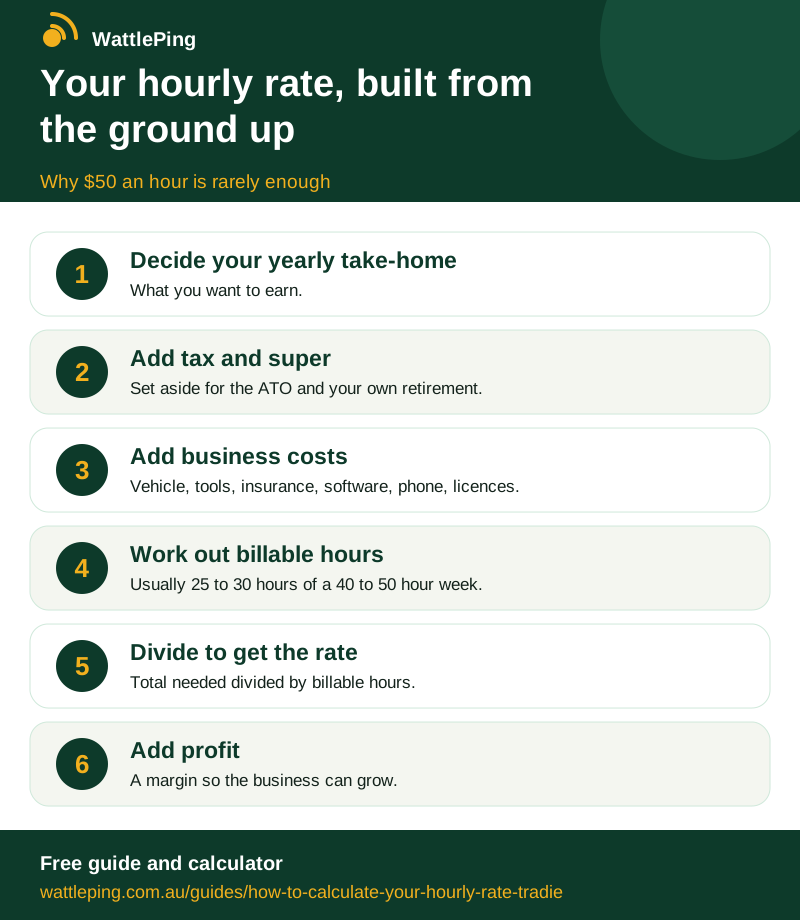
Free to share with a link back. Copy the code below to embed it on your site.
CopiedSources and further reading
This guide is general information, not legal, tax or financial advice. Rules change and differ by state, so check with the ATO, your state regulator or your accountant before you act.
Keep reading
More in Quoting and pricing: How to quote a job: a step-by-step guide for tradies · Markup vs margin: the difference that decides your profit · How to follow up a quote without sounding pushy · Quote or estimate? Why the word matters · Seven reasons customers say nothing after your quote. All guides, WattlePing features, pricing.