Markup vs margin: the difference that decides your profit
Markup is the percentage you add to your cost. Margin is the percentage of the selling price that is profit. A 25% markup gives a 20% margin. To get a 25% margin you need a 33.3% markup.
This is one of the most common and costly pricing mistakes in the trades. A tradie wants a 30% margin, adds 30% to costs, and ends up with a margin of about 23%. On a $50,000 year of materials, that gap is real money. The two terms sound similar but they measure different things. Once you see it, you will not mix them up again.
- Markup is on cost. Margin is on price.
- Markup % is always bigger than margin % for the same price.
- Selling price = cost / (1 - margin).
- Decide which one you are targeting and stick to it.
The definitions
Markup is how much you add to what something costs you. Margin is how much of the final price is profit.
| Markup | Margin | |
|---|---|---|
| Based on | Your cost | Your selling price |
| Formula | (Price - cost) / cost | (Price - cost) / price |
| For cost $100, price $125 | 25% | 20% |
| Can exceed 100%? | Yes | No |
Work it out
Markup and margin calculator
Enter what it costs you and the markup you want. See the selling price, your profit and the margin.
- Selling price
- Profit
- Margin (profit as a share of the price)
General guide only. Check your own numbers and, for tax, ask your accountant.
The mistake that costs money
A tradie buys materials for $1,000 and adds 30% markup: price $1,300. Profit: $300.
Margin is $300 / $1,300 = 23.1%, not 30%.
To hit a true 30% margin, price = $1,000 / (1 - 0.30) = $1,428.57. That is a markup of 42.9%.
Example figures for illustration.
Conversion table
Formula: markup = margin / (1 - margin). And in reverse: margin = markup / (1 + markup).
| Target margin | Markup needed |
|---|---|
| 10% | 11.1% |
| 15% | 17.6% |
| 20% | 25.0% |
| 25% | 33.3% |
| 30% | 42.9% |
| 40% | 66.7% |
| 50% | 100.0% |
Which should you use?
- Markup is quick on materials. Add a percentage to the supplier price.
- Margin is better for judging the profitability of a whole job or business, because it ties to revenue.
- Whichever you choose, use it everywhere. Mixing them is how mistakes creep in.
Markup on materials versus labour
Materials usually carry a markup to cover ordering, handling, delivery and risk of wastage. Labour is priced through your hourly rate, which already includes overheads and profit. Do not double up by adding a heavy markup on top of an already profitable labour rate. See how to calculate your hourly rate.
Job profit calculator
Put in what a job brought in and what it really cost. See the profit, the margin and the profit per hour.
- Profit
- Margin
- Profit per hour
General guide only. Check your own numbers and, for tax, ask your accountant.
Practical tips
- Pick your target marginDecide what profit you need on the job.
- Convert to markupUse the table or formula.
- Apply it to costAdd the markup to supplier prices.
- Check itDivide profit by price to confirm your margin.
- Review quarterlyCompare quoted margin with what you actually earned.
Real-world scenarios
This is why discounts need care. Small percentage cuts to the price can remove most of the profit when margins are thin.
Price = $480 / (1 - 0.20) = $600. Profit is $120. Markup is 25%.
Price = $2,000 x 1.15 = $2,300. Profit is $300. Margin is about 13%.
The new price is $2,070. Profit falls to $70, down from $300. A 10% discount removed 77% of the profit.
How to check your quotes after the job
- Record your final costAdd up what you actually paid for materials and your time.
- Compare with what you chargedSubtract cost from price excluding GST.
- Work out the marginProfit divided by price.
- Compare to your targetAre jobs landing where you planned?
- Adjust the next quoteIf margins are slipping, raise markup or rate.
Quick answers
What is the difference between markup and margin?
Markup is profit as a percentage of cost. Margin is profit as a percentage of selling price.
Is a 50% markup the same as a 50% margin?
No. A 50% markup is a 33.3% margin. A 50% margin needs a 100% markup.
What markup should a tradie put on materials?
Common ranges are 10 to 30 percent, depending on the trade and the material. Work out what covers your handling costs and profit.
Does margin include GST?
Calculate profit on prices excluding GST. GST is collected for the ATO, not income.
How do I calculate selling price from margin?
Price = cost divided by (1 minus margin).
Can margin be more than 100%?
No. Margin cannot reach 100%. Markup can exceed 100%.
Should I show the markup on the quote?
Usually no. Show the total price. Customers pay for the result.
What about discounts?
Discounts come out of your margin. A 10% discount on a 20% margin job takes about half of your profit.
Share this infographic
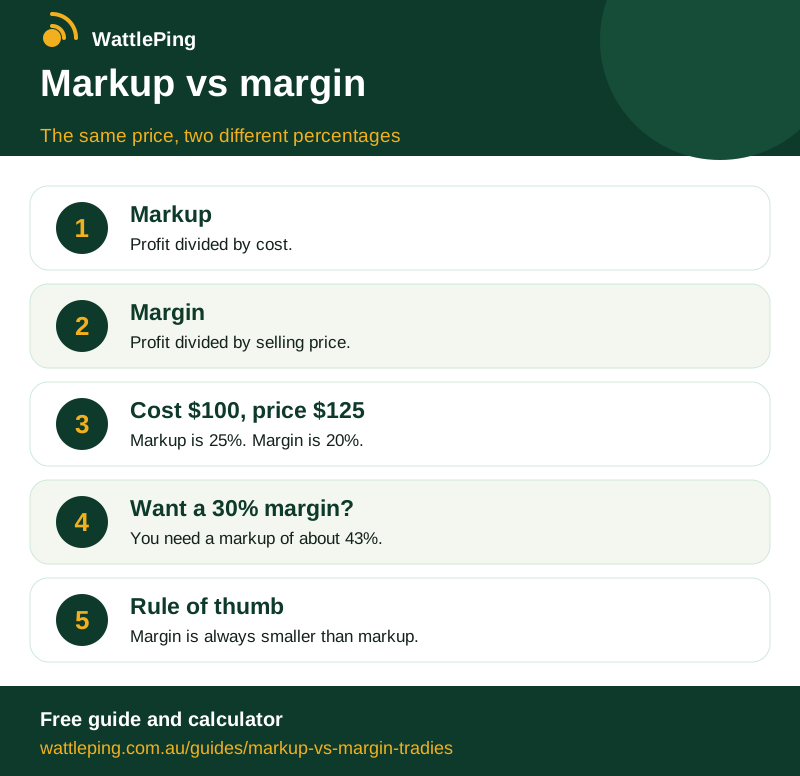
Free to share with a link back. Copy the code below to embed it on your site.
CopiedSources and further reading
This guide is general information, not legal, tax or financial advice. Rules change and differ by state, so check with the ATO, your state regulator or your accountant before you act.
Keep reading
More in Quoting and pricing: How to quote a job: a step-by-step guide for tradies · How to calculate your hourly rate as a tradie · How to follow up a quote without sounding pushy · Quote or estimate? Why the word matters · Seven reasons customers say nothing after your quote. All guides, WattlePing features, pricing.