How to quote a job: a step-by-step guide for tradies
To quote a job, work out your labour hours and rate, add materials with a markup, add GST if you are registered, state what is and is not included, set a deposit and an expiry date, and send it the same day. Then follow up within two days.
A good quote does two jobs. It wins the work, and it makes sure you are paid properly for it. Most tradies who lose money on jobs did not do the work badly, they quoted badly: missed costs, no scope, no deposit, no follow-up. This guide walks through the whole process in the order you would do it, with a worked example and a calculator.
- Price from your real costs, not from a guess or from a mate's rate.
- State what is included and what is not. Most disputes start here.
- Add a deposit, an expiry date and clear terms.
- Send it the same day and follow up in two days.
Step 1: Understand the job properly
Before you price anything, be clear on what the customer actually wants. Visit the site if the job needs it, take photos and measurements, and ask what they are expecting. Ten minutes of questions up front saves hours of argument later.
- What is the finished result they want?
- Are there access problems, old materials or hidden risks?
- Who supplies fixtures and finishes, you or them?
- What is their timeline and budget?
Step 2: Cost your time and materials
- Estimate hoursBreak the job into stages and put hours on each. Add time for travel, setup and clean up.
- Use a real hourly rateUse a rate that covers your wages, overheads and profit. See our hourly rate guide.
- List materials with supplier pricesUse current prices and include delivery.
- Add a markup on materialsHandling, ordering and risk are real costs.
- Add a contingencyA small buffer for the unexpected on riskier jobs.
Work it out
Quote total calculator
Add up labour, materials and callout to see what to quote, with GST worked out for you.
- Labour
- Materials with markup
- Subtotal
- GST
- Quote total
General guide only. Check your own numbers and, for tax, ask your accountant.
Step 3: Add GST correctly
If you are registered for GST, your quote should make clear whether prices include GST. Quoting without GST and adding it later is the quickest way to annoy a customer. Quote the total including GST and show the GST amount.
GST calculator
Add GST to a price, or take it out of a GST-inclusive price.
- Price before GST
- GST (10%)
- Price including GST
General guide only. Check your own numbers and, for tax, ask your accountant.
A worked example
Labour: 5 hours at $95 = $475. Materials: unit $1,150 plus fittings $120 = $1,270. Markup on materials at 15% = $190.50.
Subtotal: $475 + $1,270 + $190.50 = $1,935.50. GST: $193.55. Total: $2,129.05.
Deposit of 30% on acceptance: $638.72. Balance on completion.
Example figures for illustration.
Step 4: Write the quote
A quote can be one page. It just needs to be clear.
| Include | Why it matters |
|---|---|
| Your business name and ABN | Trust, and it is a legal basics item. |
| Customer name and job address | Avoids mix-ups. |
| Description of the work | Defines the scope. |
| Itemised price or clear total | Shows value and builds trust. |
| Exclusions | Stops disputes about extras. |
| Deposit and payment terms | Protects your cash flow. |
| Expiry date | Protects you from price changes. |
| Variation process | Says how extras are agreed and priced. |
Step 5: Ask for a deposit
For anything beyond a small job, ask for a deposit on acceptance. It commits the customer and covers your materials. Our deposit guide covers how much to ask.
Deposit and progress payment planner
Split a job into a deposit and progress payments. Check the deposit against your state's rules before you use it.
- Deposit
- Each progress payment
- Total after the deposit
General guide only. Check your own numbers and, for tax, ask your accountant.
Step 6: Send it fast and follow up
Customers usually go with whoever responds first and looks professional. Send the quote the same day. If you have not heard back in two days, send a polite follow-up. Most quotes that stall are not rejections, they are forgotten.
Tip. A short message is enough: 'Hi Sam, just checking you got the quote for the deck. Happy to answer any questions.'
Quote follow-up message writer
A polite follow-up you can copy and send by text or email.
- Message
Copied
General guide only. Check your own numbers and, for tax, ask your accountant.
Common quoting mistakes
- Quoting on a gut feel instead of working out the hours.
- Forgetting travel, cleanup and supervision time.
- Leaving out exclusions.
- No expiry date, so you are held to an old price.
- No deposit on a job with big materials.
- Waiting a week to send it.
Watch out. A quote that is too cheap does not win loyal customers. It wins customers who will always want a cheaper price.
Quoting different kinds of jobs
The method is the same, but where the risk sits changes with the type of job.
| Job type | Main risk | How to protect yourself |
|---|---|---|
| Small repair | Under-pricing travel and minimum time | Set a call-out minimum and say so up front. |
| Renovation | Hidden problems behind walls and floors | Add a contingency and list assumptions. |
| New install | Customer changes their mind on fittings | Fix the specification in writing and price variations. |
| Commercial work | Slow payment and complicated terms | Confirm who pays, invoice terms and any retention. |
| Emergency work | Pressure to guess a price | Quote a call-out plus hourly rate and confirm before extra work. |
Fixed price or itemised?
A fixed price is simple for the customer, and rewards you if you work efficiently. An itemised quote shows where the money goes, which builds trust on bigger jobs and makes variations easier to agree. A good middle path is a fixed total with a short list of what it includes. Whichever you pick, put the exclusions in writing.
Customers rarely compare quotes on price alone. They compare how clear the quote is, how fast it arrived and how confident you sound. A tidy one-page quote sent the same day often beats a cheaper one sent a week later.
Quick answers
Should I give a quote or an estimate?
A quote is a fixed price. An estimate is a best guess. See our quote vs estimate guide for when each is appropriate.
How long should a quote be valid for?
Commonly 14 to 30 days, shorter if material prices move quickly. State it clearly.
Should I charge for quotes?
Some tradies charge for complex quotes and credit it to the job. It is your decision, but say so up front.
Should a quote include GST?
If you are registered, quote the total including GST and show the GST amount.
How much deposit should I ask for?
Commonly 10 to 30 percent, more if you have to order materials. See our deposit guide.
What if the job changes?
Agree changes in writing as a variation with the price before you do the work.
How quickly should I follow up?
About two days later, then again a few days after. Keep it short and friendly.
Do I need software to quote?
No, but software saves time and looks professional. Compare options in our quoting software guide.
Share this infographic
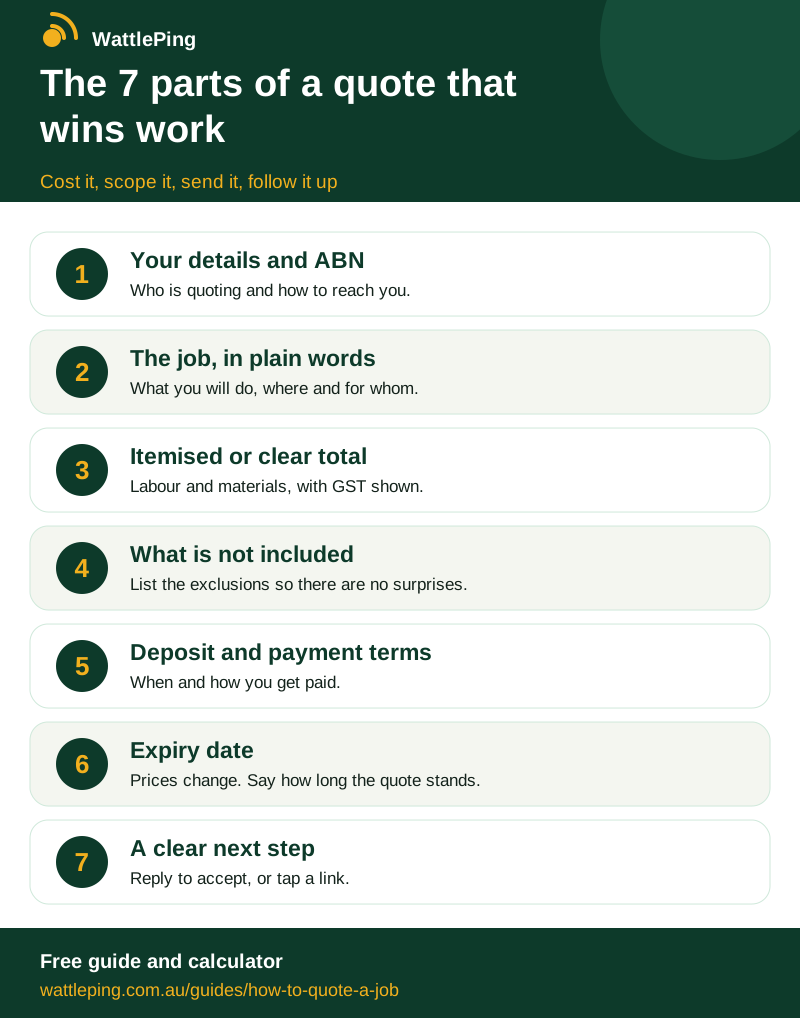
Free to share with a link back. Copy the code below to embed it on your site.
CopiedSources and further reading
This guide is general information, not legal, tax or financial advice. Rules change and differ by state, so check with the ATO, your state regulator or your accountant before you act.
Keep reading
More in Quoting and pricing: How to calculate your hourly rate as a tradie · Markup vs margin: the difference that decides your profit · How to follow up a quote without sounding pushy · Quote or estimate? Why the word matters · Seven reasons customers say nothing after your quote. All guides, WattlePing features, pricing.