Guides / Invoicing and getting paid
How to ask for a deposit on a trade job
Most tradies ask for a deposit of around 10 to 30 percent on acceptance, more when materials must be ordered. Deposit rules differ by state and by type of work, so check your state's limits before you set a figure, and put the amount and the refund terms in writing.
A deposit pays for materials, confirms the customer is serious and puts you on the calendar. It is also the thing tradies feel most awkward asking for. This guide makes it routine.
- A deposit covers materials and confirms the booking.
- Check your state's limits before setting a percentage.
- Make it routine and put it on every quote.
Why take a deposit
- It covers materials so you are not funding the job yourself.
- It filters out time-wasters.
- It makes cancellations less likely.
Check your state's rules first
For home building and renovation, some states cap the deposit as a percentage of the contract price, and the cap can depend on the size of the job. Smaller jobs and different trades may have different rules. Look up your state regulator or fair trading office before you set a figure.
Plan the payments
Deposit and progress payment planner
Split a job into a deposit and progress payments. Check the deposit against your state's rules before you use it.
- Deposit
- Each progress payment
- Total after the deposit
General guide only. Check your own numbers and, for tax, ask your accountant.
How to ask
Put it on the quote in a plain line: 'A 10% deposit confirms your booking.' Make it the same for everyone. When it is routine it stops feeling personal.
Tip. Collect it by link or bank transfer so there is a clear record.
Refunds
Say what happens if the customer cancels, and keep records of the money you spent on materials. Be fair and write it down.
How much deposit to ask for
| Job | Typical approach |
|---|---|
| Small repair under a few hundred dollars | Often none, pay on completion. |
| Medium job with materials | 10 to 30 percent on acceptance. |
| Special-order materials | Enough to cover the order. |
| Large renovation or build | A regulated deposit, then staged payments. |
| Commercial work | Per the contract, often claims on a schedule. |
Watch out. Many states limit deposits on residential building and renovation work. Check your state's rules before you set a figure, because charging too much can breach them.
Work out your deposit
Deposit and progress payment planner
Split a job into a deposit and progress payments. Check the deposit against your state's rules before you use it.
- Deposit
- Each progress payment
- Total after the deposit
General guide only. Check your own numbers and, for tax, ask your accountant.
What to put in writing
- Quote the deposit clearlyAmount and percentage.
- Say what it coversMaterials, booking or both.
- Explain refundsWhat is refundable and when.
- Issue a receiptDate, amount and job.
- Record it against the invoiceSo the final invoice shows what is left.
'A deposit of $[amount] ([x]% of the contract price) is payable on acceptance to secure your booking and order materials. The balance is due [on completion / in stages as set out below]. If you cancel after the materials are ordered, the cost of those materials may be deducted from the refund.' Check wording for your state and trade with a lawyer or industry body.
Handling objections
Some customers push back on paying anything first. Explain that the deposit secures the date and covers materials you have to buy, and that you will give a receipt. A customer who will not pay a reasonable deposit on a job with real material costs is often a customer who pays late.
Mistakes with deposits
- Asking for more than your state allows on residential work.
- Taking a deposit with no written agreement or receipt.
- Spending the deposit on other things when the job is delayed.
- Being vague about what is refundable.
- Not recording the deposit against the final invoice.
A real-life scenario
A landscaper quoted a $12,000 garden with $3,500 of special-order pavers. He asked for a deposit sized to cover the order, wrote down what was refundable if the customer cancelled and issued a receipt. When the customer later changed their mind, the written terms made the conversation short and fair: the unused deposit was returned, less the cost of the pavers already ordered.
A clear deposit clause protects the customer as much as you.
Quick answers
How much deposit should I ask for?
It depends on the job, your materials cost and your state's rules. Cover what you must spend up front, within any legal limit.
Can I take a deposit for small jobs?
Yes, many tradies do for jobs with special-order materials.
Is a deposit refundable?
It depends on your contract and your state's rules. State refund terms up front and get advice for large jobs.
Can I ask for 50 percent up front?
Often not for residential building work, where states limit deposits. Check your state's rules.
Do I charge GST on a deposit?
If you are registered for GST, a deposit is generally part of the sale. Ask your accountant how it applies to you.
Should I give a receipt for a deposit?
Yes, every time. It protects both of you.
Share this infographic
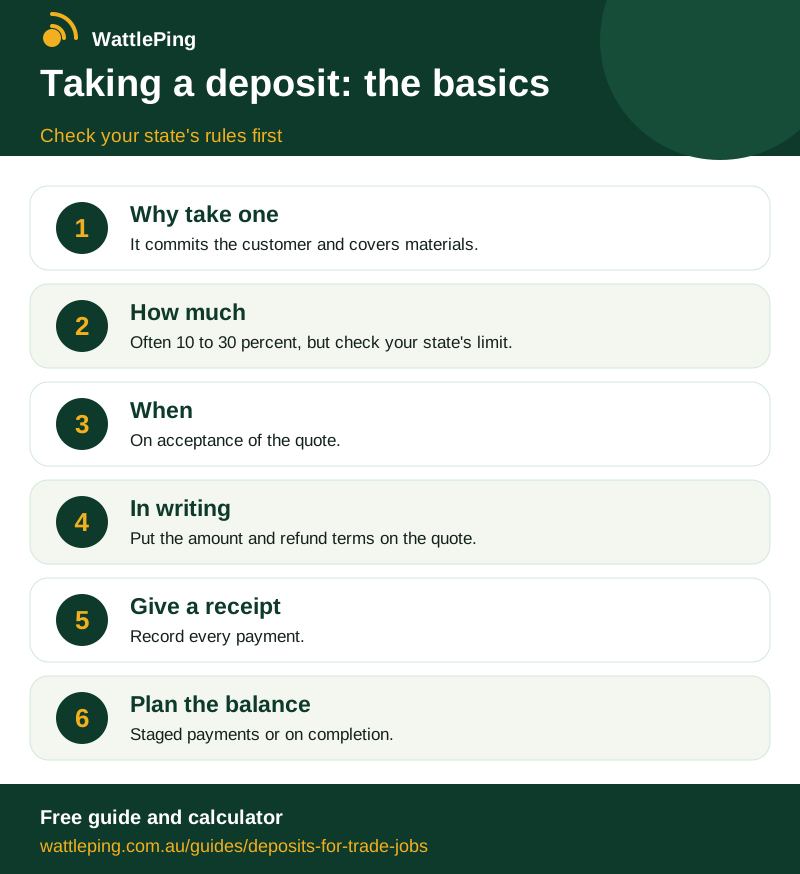
Free to share with a link back. Copy the code below to embed it on your site.
CopiedSources and further reading
This guide is general information, not legal, tax or financial advice. Rules change and differ by state, so check with the ATO, your state regulator or your accountant before you act.
Keep reading
More in Invoicing and getting paid: How to write a valid tax invoice in Australia (with a free checklist) · How to chase an overdue invoice without losing the customer · Payment terms that actually get you paid · Progress payments: get paid as the job moves along · How to get paid faster as a tradie: 12 things that work. All guides, WattlePing features, pricing.