Guides / Invoicing and getting paid
Progress payments: get paid as the job moves along
Progress payments split a larger job into stages, each paid when a milestone is reached. They keep your cash flow healthy and reduce risk for both sides. Tie each payment to a visible milestone and set out the schedule in the contract. Rules differ by state for building work, so check yours.
On a job that runs for weeks, waiting until the end to be paid is risky. Progress payments tie money to milestones everyone can see.
- Tie payments to milestones everyone can see.
- Photograph each stage before invoicing.
- Write the schedule into the contract.
Pick clear milestones
Choose points that are easy to agree on, like 'frame complete' or 'rough-in done', not 'about halfway'.
Match payments to cost
Early stages often cost more because of materials. Set payments so you are never carrying much of the job on your own money.
Plan the schedule
Deposit and progress payment planner
Split a job into a deposit and progress payments. Check the deposit against your state's rules before you use it.
- Deposit
- Each progress payment
- Total after the deposit
General guide only. Check your own numbers and, for tax, ask your accountant.
Invoice at each stage
Send the invoice when the stage is finished, with a photo if you can. A picture of the finished stage answers most questions.
Write it into the contract
State the stages and amounts before you start. For larger building work, your state may have specific rules about progress payments, so check them.
Tip. Photograph each stage before you invoice. Photos settle arguments quickly.
An example schedule
- Deposit when the contract is signed.
- Second payment when the frame or main structure is complete.
- Third payment at lock-up or rough-in stage.
- Final payment on completion and handover.
Keep stages fair
Customers feel safer when each payment clearly matches finished work. That protects you too, because a customer who understands the schedule is less likely to dispute a stage.
A sample schedule
| Stage | Milestone | Share of price |
|---|---|---|
| 1 | Deposit on acceptance | 10% |
| 2 | Materials on site and work started | 25% |
| 3 | Rough-in complete | 30% |
| 4 | Fit-off complete | 25% |
| 5 | Completion and handover | 10% |
Example figures for illustration.
Why progress payments work
- You are never far ahead of what you have been paid.
- The customer pays for work they can see.
- Problems are caught early, not at the end.
- Large invoices are smaller and easier to pay.
- A stalled payment tells you early that something is wrong.
Write it into the contract
- List milestonesDescribe each one in plain words.
- Set the percentage or amountFor each stage.
- Say when payment is dueFor example, 7 days from invoice.
- Say what happens if unpaidPause and notice steps.
- Both sides signKeep copies.
- Follow itInvoice when the milestone is reached, not later.
Watch out. Rules for building work, including payment claims and limits on staged payments, differ by state. For larger jobs, check your state's requirements or speak to your industry body before you set a schedule.
Mistakes with progress payments
- Vague milestones such as 'when half done'.
- Falling behind on invoicing so the schedule means nothing.
- Taking payments ahead of the work, which can breach rules and cause disputes.
- Not recording variations separately.
- Skipping a written schedule on larger jobs.
A real-life scenario
A plasterer quoting a $24,000 renovation set five milestones: deposit, sheets hung, first coat, final sand and completion. At each stage he took photos, sent an invoice that day and referred back to the schedule in the contract. When one payment ran late he paused after giving written notice, and the customer paid within two days.
Photos, short invoices and a written schedule make staged payments routine instead of awkward.
Quick answers
Can I stop work if a stage is unpaid?
Often yes if your contract says so, but rules differ by state. Get advice for larger jobs.
How many stages is right?
Enough that no stage is large, but not so many you drown in invoices.
What is a progress payment?
A payment made when a defined stage of the job is complete, instead of one payment at the end.
How many stages should I use?
Three to six is common. Use more only for large jobs.
Can I stop work if a progress payment is late?
Depending on your contract and state rules, you may be able to pause after giving notice. Get advice for your situation.
Do progress payments need a written contract?
Yes, it is strongly recommended and often required for larger residential work.
Share this infographic
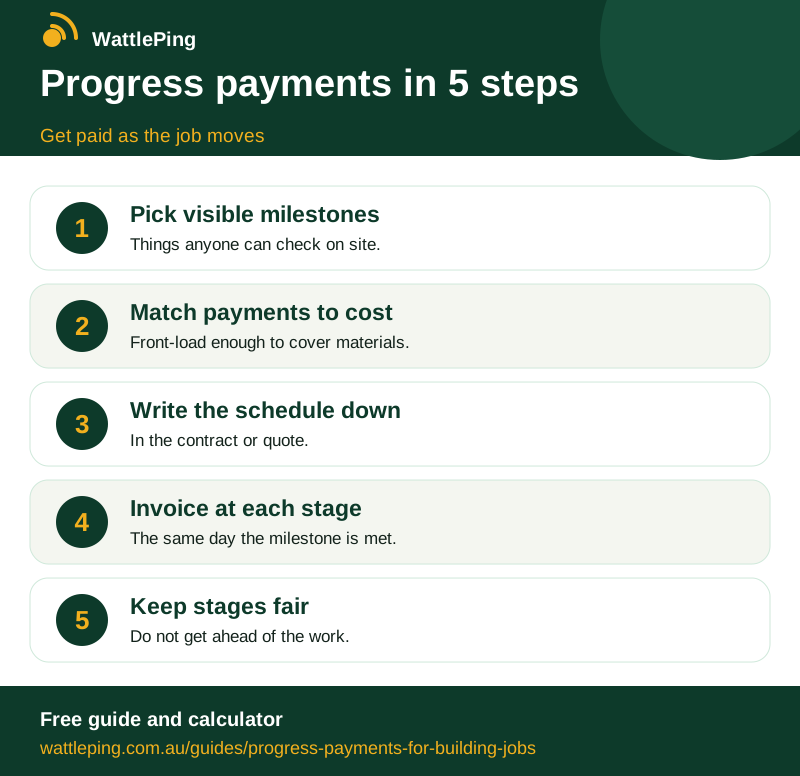
Free to share with a link back. Copy the code below to embed it on your site.
CopiedSources and further reading
This guide is general information, not legal, tax or financial advice. Rules change and differ by state, so check with the ATO, your state regulator or your accountant before you act.
Keep reading
More in Invoicing and getting paid: How to write a valid tax invoice in Australia (with a free checklist) · How to chase an overdue invoice without losing the customer · Payment terms that actually get you paid · How to ask for a deposit on a trade job · How to get paid faster as a tradie: 12 things that work. All guides, WattlePing features, pricing.