Guides / Invoicing and getting paid
How to get paid faster as a tradie: 12 things that work
To get paid faster, ask for a deposit, state payment terms on the quote, invoice the day the job finishes, make paying easy with a link or bank details, and send reminders on a fixed schedule before and after the due date.
Most tradies are not short of work, they are short of cash because customers pay late. Chasing money is stressful, and the longer an invoice sits, the less likely it is to be paid in full. The good news is that nearly all late payment can be reduced by a handful of habits, set up before the job starts. These are the twelve that work.
- Set expectations before the job, not after it.
- Invoice the day the job finishes.
- Make paying as easy as one click.
- Remind on a schedule, politely and consistently.
Why late payment happens
Customers rarely pay late out of malice. Usually the invoice was slow, unclear, hard to pay or forgotten. Fix those and most problems go away.
Before the job
- Take a depositAsk for a deposit on acceptance, especially if materials are involved.
- Put terms on the quoteSay when payment is due, for example 7 or 14 days, and how to pay.
- Use staged paymentsBreak larger jobs into milestones so you are not waiting until the end.
- Check the paying partyMake sure you know who is responsible for the bill: owner, landlord or agent.
Choose your payment terms
Payment due date calculator
Work out the due date from the invoice date and your payment terms.
- Payment due
- Status today
General guide only. Check your own numbers and, for tax, ask your accountant.
At the end of the job
- Invoice the same daySend it before you leave the site or that evening.
- Make it clearInclude the amount, due date and how to pay.
- Give a payment linkCards and bank links are faster than cheques.
- Say thanksA short note keeps goodwill and reminds them to pay.
Reminders that work
A reminder is not an insult, it is customer service. Set a schedule and stick to it so you are not deciding how awkward you feel each time.
| When | What to send |
|---|---|
| 2 days before due | A friendly heads up with the link. |
| On the due date | A short reminder. |
| 3 days overdue | A polite follow-up asking if there is a problem. |
| 10 days overdue | A firmer message with the amount and a deadline. |
| 21 days overdue | A final notice before further action. |
What to say
Keep it short, specific and friendly. The tone does most of the work.
'Hi Sam, just a reminder that invoice 1042 for $2,420 was due on Friday. You can pay by the link below. Let me know if there is any problem. Thanks, Jo.'
When an invoice is seriously overdue
If friendly reminders do not work, move to a written final notice, and consider a letter of demand. Our overdue invoice guide covers the steps. Rules differ by state and by type of job, so ask your accountant or lawyer before escalating.
Watch out. Do not threaten or harass a customer. Keep every message calm, factual and in writing.
Check your numbers
If most of your income sits in unpaid invoices, track it. Knowing the total outstanding each week keeps it front of mind. See our weekly admin routine.
Weekly admin routine
0 of 8 done. Your ticks stay on this device.
Make paying easy
Every extra step between a customer and paying is a reason to delay. Remove the friction.
Put the amount, the due date and the payment method at the top of the invoice, not buried at the bottom. Offer more than one way to pay: a bank transfer with your details, and a link for cards. Include your invoice number as the reference so you can match the payment. Send it as a link or PDF the customer can open on a phone.
| Friction | Fix |
|---|---|
| Customer has to find your bank details | Put them on the invoice. |
| Customer has to log into something | Use a link that opens straight to payment. |
| Customer forgets | Send reminders on a schedule. |
| Customer disputes the amount | Send a clear invoice that matches the quote. |
| Customer waits for an invoice | Invoice the same day. |
Different customers, different approach
- Homeowners: deposit up front, payment on completion. Friendly reminders work well.
- Landlords and property managers: confirm the invoicing process and payment cycle at the start. Some pay monthly.
- Builders and head contractors: agree the terms in writing and invoice on their schedule. Progress claims may have rules attached.
- Strata and commercial clients: they may need purchase order numbers, so ask first.
Quick answers
What payment terms should I use?
Seven to fourteen days is common for tradies. Shorter for small jobs, and use deposits and staged payments for larger ones.
Should I charge late fees?
Only if you stated them before the work and they are reasonable. Check with your accountant or lawyer.
Is it okay to ask for a deposit?
Yes. It is normal for jobs with materials or booked time.
When should I send the invoice?
The same day the job finishes.
How do I chase a customer without being rude?
Be brief and friendly, ask if there is a problem, and offer an easy way to pay.
Should I accept card payments?
Yes, if the fees are worth the faster payment. A payment link makes it simple.
Can I stop work if I am not paid?
On staged jobs you can usually pause if a progress payment is overdue, depending on your contract. Check your agreement.
What about customers who never pay?
Escalate in writing and get advice. A letter of demand is often enough.
Share this infographic
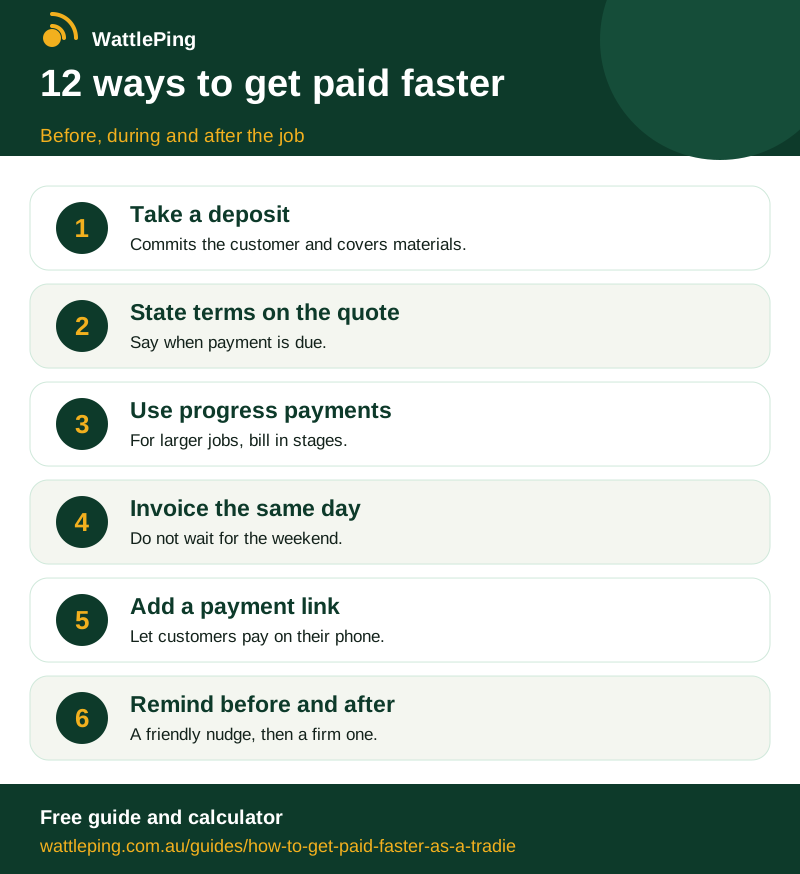
Free to share with a link back. Copy the code below to embed it on your site.
CopiedSources and further reading
This guide is general information, not legal, tax or financial advice. Rules change and differ by state, so check with the ATO, your state regulator or your accountant before you act.
Keep reading
More in Invoicing and getting paid: How to write a valid tax invoice in Australia (with a free checklist) · How to chase an overdue invoice without losing the customer · Payment terms that actually get you paid · How to ask for a deposit on a trade job · Progress payments: get paid as the job moves along. All guides, WattlePing features, pricing.