Guides / ABN, GST and tax basics
Do you need to register for GST as a tradie? The $75,000 rule, explained
Yes, once your GST turnover (sales before GST) reaches $75,000 in any 12-month period, or you expect it to, you must register for GST, generally within 21 days. Under $75,000 registration is optional, except for ride-sharing drivers, who must register from their first fare.
Most Australian tradies hit the GST threshold sooner than they expect. One good quarter, a big job or a new apprentice and your sales jump. Miss the deadline and you can owe the ATO GST on jobs where you never charged it. This guide shows exactly how the rule works, how to check where you stand, and what to do next.
- The threshold is $75,000 GST turnover, measured on sales before GST.
- Check it two ways: your last 12 months, and your next 12 months.
- You generally have 21 days to register once you know you will pass it.
- Registering early is allowed and often smart.
The short answer
You must register for GST if your GST turnover is $75,000 or more in a 12-month period, or you expect it to be. GST turnover means your business sales before GST is added. It is about income, not profit, so a tradie with $80,000 in sales and $20,000 in profit still has to register.
What counts as GST turnover
Your GST turnover is your total business sales, with GST left out. It includes taxable sales and GST-free sales. A few things are not counted, such as the GST you charge, input-taxed sales like residential rent, and one-off sales of business assets. If anything on your books looks unusual, ask your accountant or the ATO how it is treated.
- Counted: labour, materials you sell on, callout fees, subcontract income, deposits that relate to work you will do.
- Not counted: the GST itself, loans, money you put into the business, and personal income such as wages from another job.
Tip. Use your invoicing or accounting software to add up sales before GST for the last 12 months. Do not use your bank balance, which also contains GST, tax money and personal transfers.
The two tests you must pass
There are two ways to cross the line, and you have to check both. The ATO calls them the current turnover test and the projected turnover test.
| Test | What you check | When you must register |
|---|---|---|
| Current | Your GST turnover for the last 12 months, checked at the end of every month | As soon as it reaches $75,000 |
| Projected | What you reasonably expect your turnover to be over the next 12 months | As soon as you expect to reach $75,000 |
Worked example: Sam the sparky
Sam started his own electrical business in July. He checks his rolling 12-month sales at the end of each month and spots the problem in December.
In January his 12-month sales reach $79,000, so he has passed $75,000. But he should have noticed earlier: in October he signed a $40,000 commercial rewire starting in February. His projected turnover for the next 12 months was well over $75,000 the day he signed it.
That means his 21 days started in October, not January. If he registers late, he could owe GST on sales since the date he should have registered, even on invoices where he did not charge GST.
Example figures for illustration.
How to register for GST
- Get an ABNYou need an ABN first. Applying is free on the Australian Business Register. Avoid sites that charge a fee.
- Register for GSTYou can register online through your ATO online services for business, through your tax agent, or by phone. Many people tick the GST box when they apply for their ABN.
- Choose your reporting cycleMost small businesses lodge a BAS quarterly. You can ask for monthly if that helps you manage cash.
- Set your start dateYour registration is effective from the date you must register, or the date you choose if you are registering early. Check this with your accountant.
- Update quotes and invoicesShow GST on every quote and issue tax invoices from your start date.
What changes once you are registered
For many tradies the biggest change is pricing. A customer who is not GST-registered, such as a homeowner, pays 10% more. A customer who is a registered business gets that GST back as a credit, so it costs them nothing.
| Not registered | Registered | |
|---|---|---|
| Charge GST on sales | No | Yes, 10% on taxable sales |
| Claim GST credits on purchases | No | Yes, with a valid tax invoice |
| Lodge a BAS | Not for GST | Yes, usually quarterly |
| Invoice type | Plain invoice with your ABN | Tax invoice with GST shown |
| Customers who are GST-registered | Cannot claim GST back | Can claim GST back |
The pricing trap
If you quote $1,000 and do not say whether GST is included, the price is generally treated as GST-inclusive. You would owe one-eleventh of it to the ATO and keep about $909. Always write 'plus GST' or 'including GST' on every quote.
Quoted $1,000 with no GST wording: GST is $90.91 and you keep $909.09.
Quoted $1,000 plus GST: the customer pays $1,100, GST is $100 and you keep $1,000.
Watch out. Do not wait for your accountant at tax time to work out GST. Prices set before you register can lock you into jobs where the GST comes out of your pocket.
Should you register before you have to?
Voluntary registration is allowed at any turnover. It makes sense when most of your customers are GST-registered businesses, when you are about to make a large purchase such as a ute or equipment, or when you expect to grow past the threshold soon.
- For: claim GST back on tools, vehicles and materials, and look established to commercial clients.
- Against: you take on BAS paperwork, and homeowner customers see a higher price.
- Remember: once you register you generally need to stay registered while you operate above the threshold. Ask your accountant before you cancel.
Common mistakes to avoid
- Waiting until the end of the financial year to check turnover.
- Looking only at the last 12 months and forgetting the projected test.
- Counting profit or bank balance instead of sales before GST.
- Not writing 'plus GST' on quotes.
- Registering for GST but still issuing plain invoices.
- Spending the GST you collect. It belongs to the ATO.
Check your own numbers
Enter your last 12 months and next 12 months of sales before GST.
Do I need to register for GST?
Check your GST turnover (your sales before GST) against the $75,000 registration threshold.
- What this means
- Room left under $75,000
General guide only. Check your own numbers and, for tax, ask your accountant.
Real-life situations
| Situation | What it generally means |
|---|---|
| You turned over $60,000 last year and are steady | Under the threshold. Registration is optional. |
| You are on track for $80,000 this year | You expect to pass $75,000. Register within 21 days of knowing. |
| You drive for a rideshare service | Special rules apply regardless of turnover. Check with the ATO. |
| You started this year and have a big job coming | Your projected turnover counts. Check the current and projected tests. |
| Your customers are mostly businesses | They may prefer GST-registered suppliers, so consider registering. |
Quick answers
What is the GST threshold in Australia?
$75,000 GST turnover for most businesses. Non-profit organisations have a higher threshold, and ride-sharing drivers must register regardless of turnover.
Is the threshold based on profit?
No. It is based on sales before GST. Profit is not part of the test.
How long do I have to register?
Generally 21 days from the day you know your turnover has reached or will reach $75,000.
What happens if I register late?
You may owe GST on sales from the date you should have registered, even if you did not charge it. Talk to your accountant or the ATO as soon as you realise.
Can I register for GST voluntarily?
Yes. You can register at any turnover if you have an ABN.
Do sole traders need to register for GST?
Yes, the same threshold applies to sole traders, partnerships and companies.
Does GST apply to every sale I make?
Most sales of goods and services are taxable at 10%. Some are GST-free or input-taxed. Your accountant can confirm how your type of work is treated.
Can I cancel my GST registration later?
Possibly, if your turnover drops below the threshold and you expect it to stay there. Check with the ATO or your accountant before cancelling.
Share this infographic
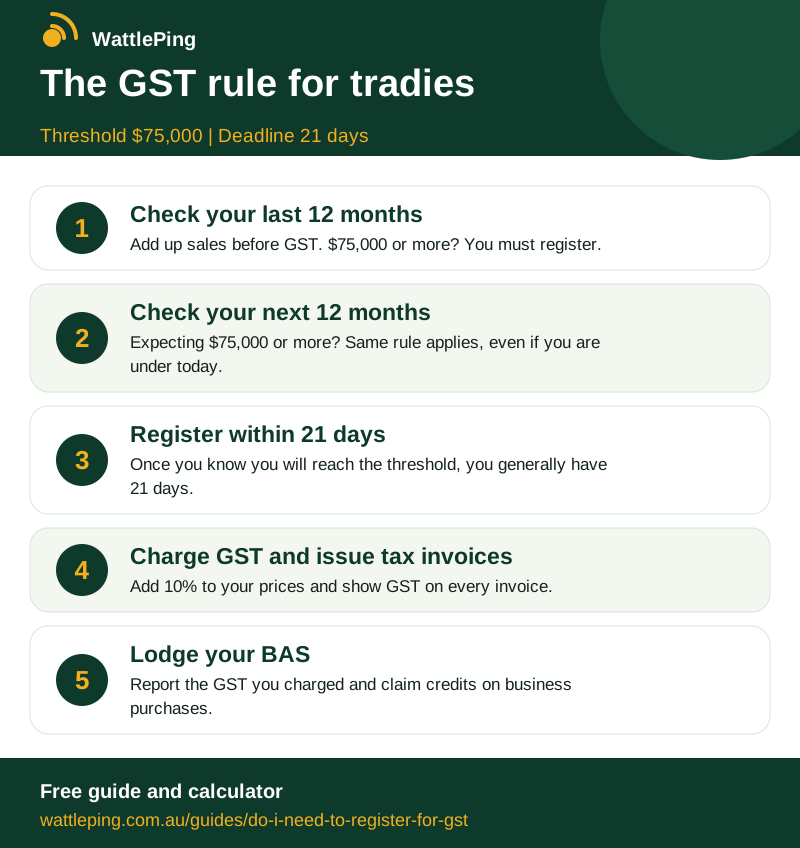
Free to share with a link back. Copy the code below to embed it on your site.
CopiedSources and further reading
This guide is general information, not legal, tax or financial advice. Rules change and differ by state, so check with the ATO, your state regulator or your accountant before you act.
Keep reading
More in ABN, GST and tax basics: How to calculate GST: adding it, taking it out and avoiding the usual slip · BAS for tradies: what it is, what goes on it and when it is due · Tax deductions for tradies: what you can claim and how to prove it · How much of each payment to put aside for tax · The instant asset write-off explained for tradies. All guides, WattlePing features, pricing.