Guides / ABN, GST and tax basics
How much of each payment to put aside for tax
A common method is to split every payment into three buckets: GST (one-eleventh of the total if you are registered), income tax and super savings, and the rest for running the business and your pay. Many tradies set aside roughly 20 to 30 percent of profit for income tax, but your own number depends on your income, so check with your accountant.
Sole traders do not have tax taken out of each payment. That feels great until the bill arrives. A simple habit fixes it.
- Keep GST and income tax in a separate account.
- Move the money the day you are paid.
- Ask your accountant for your percentage.
Two buckets
- GST: not your money. If you are registered, one-eleventh of GST-inclusive sales belongs to the ATO.
- Income tax: a share of your profit. Ask your accountant what percentage suits you.
Try the calculator
The percentage is a placeholder. Use the one your accountant recommends.
Tax set-aside calculator
Put a slice of every payment aside for tax. Pick a percentage your accountant is happy with.
- Set aside for income tax
- Set aside for GST
- Left to spend
General guide only. Check your own numbers and, for tax, ask your accountant.
Make it automatic
Open a separate savings account. Each time you are paid, move the GST and tax share across the same day.
Tip. If it is out of sight it is easier not to spend it.
Remember super and instalments
If you have staff, super is on top (see the super guide). You may also pay PAYG instalments through the year.
A simple routine
- Open a separate savings account just for tax and GST.
- Each time a customer pays, move the GST portion across the same day.
- Move your agreed income tax share across as well.
- Once a quarter, check the balance against your BAS and your accountant's estimate.
Why it works
Money you do not see is money you do not spend. Most tax stress comes from spending cash that was never really yours. A small, boring routine removes the surprise.
Review it with your accountant
Your ideal percentage changes with your profit, deductions and structure. Ask your accountant for a figure at the start of each year and again if your income jumps.
A worked split
GST: $5,500 / 11 = $500. Price before GST: $5,000.
Suppose the costs of the job were $2,000. Profit: $3,000.
Tax bucket at 25% of profit: $750. Super at 10% of profit: $300.
Left for you and the business: $5,500 - $500 - $750 - $300 = $3,950, of which $2,000 covers costs.
Example figures for illustration.
Tax rates are not flat
Income tax in Australia is progressive, so the percentage you owe rises as your profit rises. A flat set-aside percentage is a safety buffer, not the exact figure. Your accountant can tell you what percentage to use for your income, and whether you pay PAYG instalments through the year. If you set aside too much, you simply get it back or have it as savings.
| If your profit is... | A cautious approach |
|---|---|
| Low, under the tax-free threshold | Ask your accountant. You may owe little income tax. |
| Moderate | Set aside a steady percentage, reviewed each quarter. |
| High or rising fast | Set aside more and ask about instalments. |
Make it automatic
- Open a separate savings accountLabel it Tax and GST.
- Move GST when you are paidOne-eleventh of every payment.
- Move your tax percentage weeklySame day each week.
- Pay BAS and instalments from itNot from your everyday account.
- Review each quarterCompare the balance with what you expect to owe.
Mistakes that cause tax-time shocks
- Spending GST as if it were income.
- Setting aside a percentage of sales instead of profit.
- Ignoring PAYG instalments and super.
- Keeping tax money in the everyday account.
- Not asking for an estimate until after the financial year.
A real-life scenario
A sole-trader plumber earned more than he expected one year and faced a tax bill bigger than his savings. The next year he opened a separate account, moved GST and a fixed percentage of profit each week and asked his accountant for a mid-year estimate. At tax time the money was there and he knew the number in advance.
The system matters more than the exact percentage. A steady habit with a quarterly check beats a perfect formula you never use.
Quick answers
What percentage should I set aside?
It depends on your profit and situation. A registered tax agent can give you a figure.
Is the calculator tax advice?
No. It is a planning tool.
How much of my income should I save for tax?
It depends on your profit and situation. Many tradies start with a percentage of profit and refine it with their accountant.
Do I pay tax on GST I collect?
GST is not your income. You collect it for the ATO and pay it through your BAS.
What are PAYG instalments?
Prepayments of your income tax, set by the ATO, paid through the year.
Do I need to save for super as a sole trader?
You are not required to pay yourself super, but saving for retirement is wise. Ask your accountant about contributions.
Share this infographic
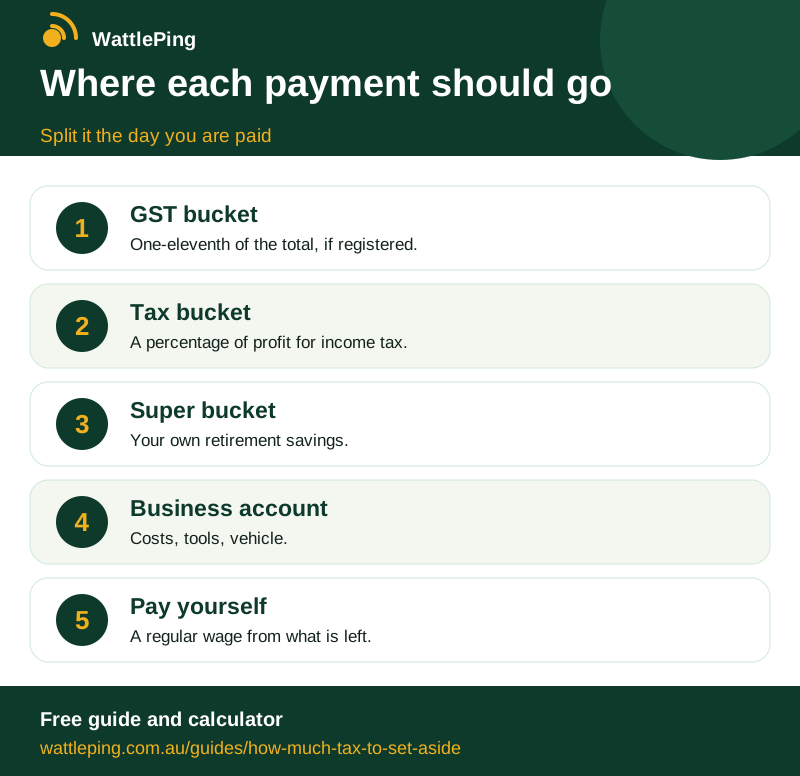
Free to share with a link back. Copy the code below to embed it on your site.
CopiedSources and further reading
This guide is general information, not legal, tax or financial advice. Rules change and differ by state, so check with the ATO, your state regulator or your accountant before you act.
Keep reading
More in ABN, GST and tax basics: Do you need to register for GST as a tradie? The $75,000 rule, explained · How to calculate GST: adding it, taking it out and avoiding the usual slip · BAS for tradies: what it is, what goes on it and when it is due · Tax deductions for tradies: what you can claim and how to prove it · The instant asset write-off explained for tradies. All guides, WattlePing features, pricing.