Guides / ABN, GST and tax basics
Tax deductions for tradies: what you can claim and how to prove it
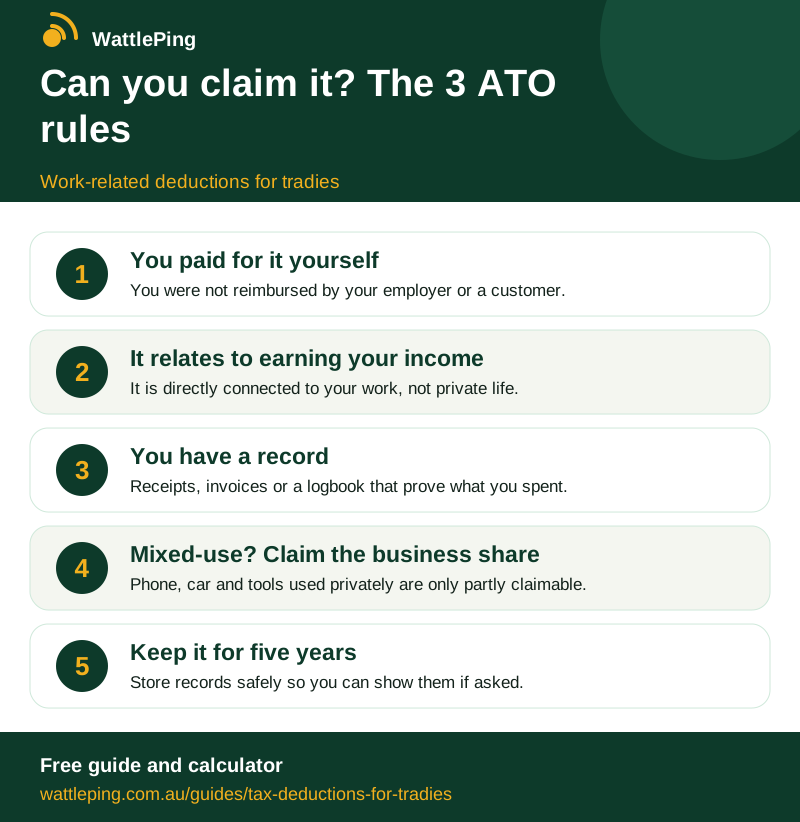
You can claim a tax deduction for a work expense if you spent the money yourself and were not reimbursed, it directly relates to earning your income, and you have a record to prove it. Keep receipts for at least five years and claim only the business share of anything used privately.
Good deductions can save a tradie thousands. Sloppy ones can cost you an audit and a bill. The ATO pays close attention to work-related claims, especially vehicles, tools and clothing, and it knows what a typical tradie's claims look like. This guide shows the rules, the common claims, the records that protect you and the mistakes that get people noticed.
- Three rules: you paid, it relates to your income, you can prove it.
- Claim only the business share of mixed-use items.
- Keep records for at least five years.
- Ask an accountant before big purchases.
The three rules
If any one of the three fails, the claim fails. These rules apply whether you are a sole trader or an employee tradie claiming work-related expenses.
- You spent the money yourself and were not reimbursed.
- It directly relates to earning your income.
- You have a record to prove it.
Common claims for tradies
| Expense | What to know |
|---|---|
| Tools and equipment | Small items may be claimed outright. More expensive items may be depreciated or, for eligible businesses, qualify for the instant asset write-off. See our write-off guide. |
| Protective clothing | Items with a protective function or a permanent work logo. Everyday clothes are generally not claimable. |
| Vehicle | Claim business use only. You can use a logbook or, for a car, the cents-per-kilometre method for up to a set number of business kilometres at the ATO's current rate. |
| Phone and internet | Claim the work-use portion, worked out from a representative period. |
| Insurance, licences, memberships | Public liability, tool insurance, trade licences and association fees are generally claimable. |
| Software and subscriptions | Quoting, invoicing and accounting tools used for business. |
| Training | Courses that maintain or improve skills you already use. Training for a new career is generally not claimable. |
Tip. Only claim the business share of anything you also use privately. A phone used 60% for work is 60% claimable, backed by a record of how you worked it out.
Vehicle claims need extra care
Work vehicles are the ATO's favourite place to look. Driving to and from your usual place of work is private travel. Travel between job sites, to pick up materials and to quote is generally business travel. Choose one method and keep the records that method needs. A logbook method needs a logbook for a continuous 12-week period. The cents-per-km method needs a reasonable way to show how you worked out your kilometres.
Watch out. Do not claim 100% of a vehicle you also use privately. The ATO compares claims to what is typical for your occupation and income.
Records to keep
Records to keep for tax
0 of 9 done. Your ticks stay on this device.
Which records the ATO accepts
Records generally need to be kept for five years from when you lodge the return. For some small claims you do not need written evidence, but you must still be able to show how you worked the amount out. Ask your accountant how this applies to you.
- Receipts and tax invoices, paper or digital.
- Bank and card statements as a backup.
- A logbook or kilometre diary for vehicle claims.
- A written note of how you worked out private use for phone and internet.
- Contracts and invoices for subcontractor payments.
Mistakes that attract attention
- Round-number claims with no records behind them.
- Claiming personal items as work expenses.
- Claiming the whole car or phone bill.
- Claiming things your employer reimbursed.
- Forgetting to keep receipts until tax time.
- Copying what a mate claims. Your situation is your own.
A simple habit that works
- Photograph receipts on the dayA photo of the receipt in a folder on your phone beats a shoebox in June.
- Use a business bank accountIt makes every business expense easy to find.
- Log your kilometresUse an app or a diary in the ute.
- Review quarterlyWhen you do your BAS, glance at the expenses and check nothing is missing.
- See your accountant before big purchasesA short call can save you from a claim you cannot use.
Employee tradie or sole trader?
The rules about what you can claim are largely the same, but the way you claim is different. Sole traders claim expenses against business income and report GST on the BAS. Employees claim work-related expenses in their tax return, and cannot claim what the employer reimbursed. Contractors operating through an ABN may fall into either, depending on the arrangement. If you are unsure which you are, ask a registered tax agent, since it affects almost everything else.
Quick answers
Can I claim my work boots?
Often yes, if they are protective footwear needed for the job. Check the ATO's guidance for your occupation.
Can I claim my ute?
You can claim the business use of a vehicle. Use a logbook or the cents-per-km method where eligible and keep records.
Do I need receipts for everything?
You generally need records for what you claim. For small amounts you may not need a receipt, but you must be able to show how you worked the amount out. Ask your accountant.
Can I claim my phone bill?
You can claim the work-use portion if you can show how you worked it out.
How long should I keep my records?
Generally five years from lodging the return.
Can I claim a home office?
Possibly, if you genuinely work from home. Ask your accountant how it applies to a tradie with a workshop or an office.
Can I claim tools I bought on credit?
Yes, when you are entitled to the deduction. The claim depends on the purchase, not on how you paid.
Should I use a tax agent?
For most tradies, yes. A registered tax agent knows what applies to you and often pays for themselves.
Share this infographic
Free to share with a link back. Copy the code below to embed it on your site.
CopiedSources and further reading
This guide is general information, not legal, tax or financial advice. Rules change and differ by state, so check with the ATO, your state regulator or your accountant before you act.
Keep reading
More in ABN, GST and tax basics: Do you need to register for GST as a tradie? The $75,000 rule, explained · How to calculate GST: adding it, taking it out and avoiding the usual slip · BAS for tradies: what it is, what goes on it and when it is due · How much of each payment to put aside for tax · The instant asset write-off explained for tradies. All guides, WattlePing features, pricing.