Guides / ABN, GST and tax basics
The instant asset write-off explained for tradies
The instant asset write-off lets eligible small businesses claim an immediate deduction for the business cost of an asset under the threshold, instead of depreciating it over years. The threshold is $20,000 per asset from 1 July 2026 for businesses with turnover under $10 million. Eligibility and timing rules apply, so check the ATO or your accountant before you buy.
The instant asset write-off lets eligible small businesses claim the full cost of a qualifying asset in the year it is first used, instead of spreading it over several years. For a new tool, trailer or piece of equipment, that can matter a lot.
- From 1 July 2026 it is $20,000 per asset.
- The asset must be used or ready for use that year.
- It cuts tax, it does not make the purchase free.
The headline rules
From 1 July 2026 the threshold is $20,000 per asset and the arrangement is permanent, for businesses with turnover under $10 million. The asset must be first used or installed ready for use in the year you claim it.
What it can apply to
- Tools and equipment.
- Work vehicles that meet the rules.
- Machinery and trade-specific gear.
Tip. Cars have separate limits. Check before you buy.
Do the maths first
A write-off reduces your tax, it does not make a purchase free. A $15,000 tool is still $15,000 out of your bank account. Make sure the job pays for it.
Check with your accountant
Thresholds and eligibility have changed often. Confirm the current rules and how the claim fits your situation before you buy.
A quick example
You buy a $12,000 trailer-mounted compressor and start using it this financial year. If it qualifies, you may claim the cost as a deduction in that year rather than spreading it over several. It reduces your taxable income, not your bank balance.
Timing
The asset must be first used or installed ready for use by the end of the financial year, not just paid for. Keep the tax invoice and note the date it went into service.
What it does and does not do
A deduction is not a refund. If you spend $18,000 on a new work vehicle that qualifies, you may deduct the business portion in one year, which lowers your taxable income. You still pay the $18,000. Whether the deduction is worth it depends on your income and cash flow.
| Question | Answer |
|---|---|
| Does it give me the money back? | No, it reduces taxable income. |
| Can I claim a private-use item? | Only the business share. |
| Does GST still matter? | GST credits are claimed separately on your BAS if you are registered. |
| Is the threshold per asset? | Yes, per asset, not an overall cap. |
| Does the rule stay the same? | Not necessarily. It has changed several times, so confirm the current rule. |
A worked example
If both qualify and are used wholly for business, you may be able to deduct $19,000 in the year they are first used or installed ready for use, subject to the rules.
If your taxable income is $90,000, the deduction could reduce it to $71,000. The tax saving is your marginal tax rate times $19,000, not $19,000 itself.
Tip. Do not buy something only for the deduction. If you do not need it, you are spending a dollar to save a few cents.
Before you buy
- Check eligibilityTurnover and business type.
- Check the assetCost, business use and timing.
- Check the current thresholdOn the ATO website.
- Do the cash flow mathsCan you afford it without hurting the business?
- Ask your accountantA short call is cheap.
- Keep the recordsTax invoice, date first used and business-use evidence.
Mistakes with the write-off
- Buying something you do not need just to get a deduction.
- Assuming the deduction is a refund.
- Forgetting the business-use percentage on mixed-use items.
- Not keeping the tax invoice and the date the asset was first used.
- Assuming the rules have not changed since last year.
A real-life scenario
A tiler needed a replacement wet saw and a trailer. Before buying, he asked his accountant, who confirmed both were likely to qualify, helped him time the purchase to the right income year and reminded him to keep the tax invoices and photos of the equipment in use. The deduction lowered his taxable income, but he treated it as a bonus, not the reason to buy.
Decide on need and cash flow first. Treat the tax benefit as a reduction in cost, not a reason.
Quick answers
Is it per purchase or per year?
It applies per asset, up to the threshold.
Can I claim GST on it as well?
If you are registered and use it for business, you can generally claim GST credits. Ask your accountant.
What is the instant asset write-off threshold?
$20,000 per asset from 1 July 2026 for eligible businesses with turnover under $10 million. Confirm the current rules with the ATO.
Does it apply to vehicles?
Some vehicles qualify subject to the rules, including car limits. Ask your accountant.
Does it apply to second-hand assets?
Often yes if the other conditions are met. Check the ATO guidance.
When must the asset be first used?
The asset must be first used or installed ready for use in the income year you claim it.
Share this infographic
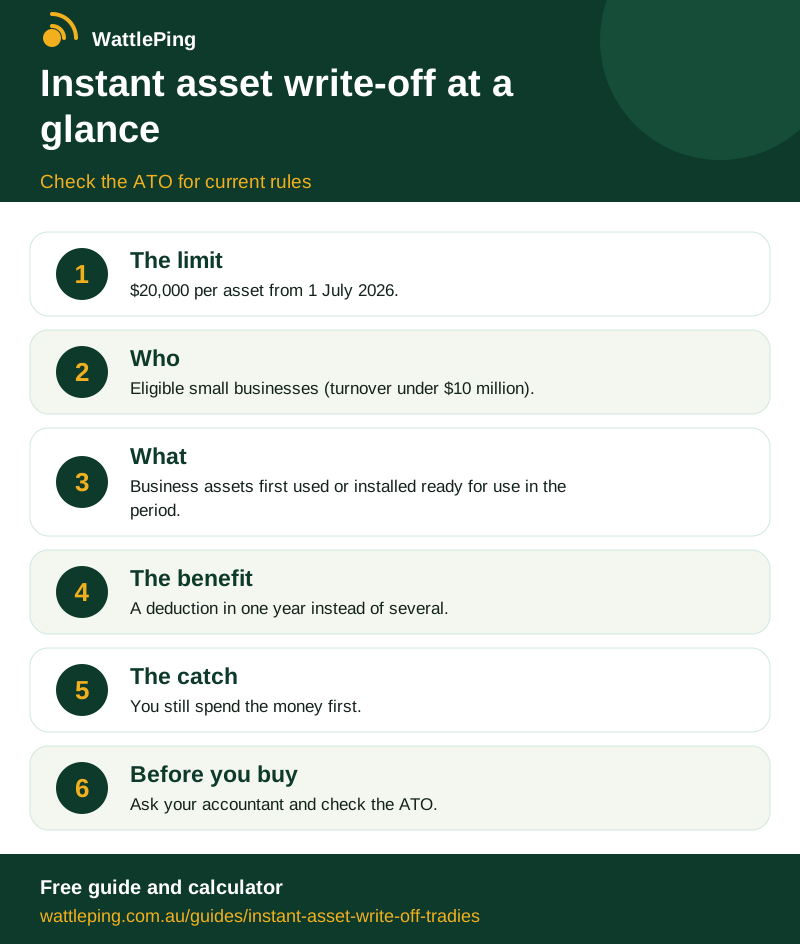
Free to share with a link back. Copy the code below to embed it on your site.
CopiedSources and further reading
This guide is general information, not legal, tax or financial advice. Rules change and differ by state, so check with the ATO, your state regulator or your accountant before you act.
Keep reading
More in ABN, GST and tax basics: Do you need to register for GST as a tradie? The $75,000 rule, explained · How to calculate GST: adding it, taking it out and avoiding the usual slip · BAS for tradies: what it is, what goes on it and when it is due · Tax deductions for tradies: what you can claim and how to prove it · How much of each payment to put aside for tax. All guides, WattlePing features, pricing.