Job costing: did that job actually make money?
Job costing means adding up what a job actually cost you in labour, materials, travel and extras, then comparing it with what you charged. The difference is your profit. Doing it after every job shows where money leaks and how to price the next one.
Plenty of busy tradies are barely profitable. The only way to know is to check each job after it finishes.
- Count your own time at a fair rate.
- Profit per hour is the number to watch.
- Compare each quote with the real result.
What to count
- Your price before GST.
- Labour, including your own time at a fair rate.
- Materials and hire.
- Fuel, parking, subcontractors and other job costs.
- The hours the job really took.
Where the money went
Example figures for illustration.
Check a job
Job profit calculator
Put in what a job brought in and what it really cost. See the profit, the margin and the profit per hour.
- Profit
- Margin
- Profit per hour
General guide only. Check your own numbers and, for tax, ask your accountant.
Read the result
Profit per hour is the number to watch. If it is below the rate you need (see the hourly rate guide), the job lost you money relative to your time.
Learn from it
Compare quote to actual. If a job type keeps overrunning, raise your price or time allowance for it.
Tip. Do it for every job for a month. Patterns appear fast.
A worked example
A bathroom job is priced at $2,400. Labour was $900, materials $650 and fuel and parking $120, and it took 14 hours. Profit is $730, a margin of about 30%, which is $52 an hour. If your target is $90 an hour, that job fell short even though it looks profitable on paper.
Where jobs usually leak money
- Unpaid trips to the supplier.
- Extra visits to fix small things.
- Variations done as favours and never charged.
- Quotes that assumed the job would go perfectly.
Make it a habit
Spend two minutes after each job writing down the real hours and costs. After a month, compare job types: some will consistently pay well and some will not. Price accordingly, or stop doing the poor ones.
Where jobs usually leak money
- Travel and supplier runs you did not count.
- Extras agreed on site but never charged.
- Materials wastage and price changes.
- Re-visits to fix small issues.
- Time spent quoting and chasing payment.
Example figures for illustration.
A full worked example
Charged: $6,000 before GST. Materials: $2,300. Subcontractor: $400. Labour: 38 hours at $70 wage-equivalent = $2,660. Other: $210 (tip fees, hire).
Total cost: $5,570. Profit: $430. Margin: 7.2%.
If your target margin is 20%, the job was priced about $1,200 too low, or took too long.
Job profit calculator
Put in what a job brought in and what it really cost. See the profit, the margin and the profit per hour.
- Profit
- Margin
- Profit per hour
General guide only. Check your own numbers and, for tax, ask your accountant.
Make it a habit
- Track time per jobUse a timer or notes.
- Keep receipts per jobPhotograph and label them.
- Run the numbers within a weekWhile you remember details.
- Record the marginIn one list.
- Review monthlyLook for patterns by job type.
- Adjust your pricingRaise rates or fix the process.
Tip. Your best and worst job types become obvious after a month. Do more of the first and re-price the second.
Mistakes in job costing
- Leaving out your own labour or valuing it at nothing.
- Forgetting travel and supplier runs.
- Mixing costs from different jobs.
- Doing it once a year instead of per job.
- Collecting numbers and never changing a price.
A real-life scenario
A builder costed his last ten small jobs and found that bathroom repairs made a healthy margin while fence jobs barely broke even, mostly because of tip fees and extra trips. He raised his fence prices, added a flat waste charge and told customers why. Margins on those jobs improved and he lost only a couple of price-sensitive customers.
The numbers told him where to push, and it took one evening.
Quick answers
Should I count my own time?
Yes, at a fair rate, otherwise a job can look profitable when it is not.
What is a good margin?
It depends on your trade and overheads. Use the break-even guide to find yours.
What is job costing?
Working out the true cost of a job and comparing it with the price to find profit.
What should I include in job costs?
Labour, materials, subcontractors, travel, hire, waste and a share of overheads.
How often should I do job costing?
After every job if you can, or at least for your regular job types.
Is job costing the same as a quote?
No. A quote is a forward-looking price. Job costing looks back at what actually happened.
Share this infographic
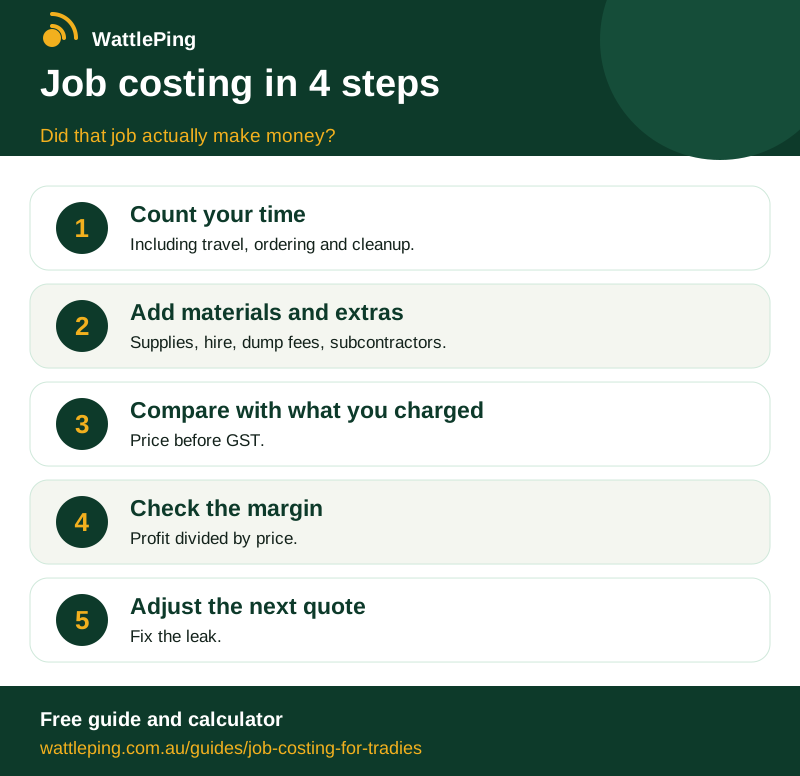
Free to share with a link back. Copy the code below to embed it on your site.
CopiedSources and further reading
This guide is general information, not legal, tax or financial advice. Rules change and differ by state, so check with the ATO, your state regulator or your accountant before you act.
Keep reading
More in Running the business: How many jobs do you need to break even? · A weekly admin routine that takes under an hour · How to choose quoting and invoicing software for your trade · Paying super for your employees, simply explained · Starting a trade business in Australia: the setup checklist. All guides, WattlePing features, pricing.