How many jobs do you need to break even?
Your break-even point is the amount of work you must do each month just to cover your fixed costs. Divide your monthly fixed costs by the profit you make on each dollar of work (your margin). Anything above that number is profit.
Fixed costs arrive whether or not you work. Knowing how many jobs cover them gives you a target and tells you when a quiet month is a problem.
- Divide fixed costs by profit per job.
- Include your own wage.
- Recalculate when costs change.
The idea
Each job leaves some profit after its direct costs. Divide your fixed monthly costs by that profit per job to see how many jobs you need.
Seeing the break-even point
Example: $750 profit per job against $9,000 fixed costs. At 100% you break even.
Calculate yours
Break-even calculator
How many jobs do you need each month just to cover your fixed costs?
- Jobs needed each month
- Sales needed each month
- Profit left per job to cover fixed costs
General guide only. Check your own numbers and, for tax, ask your accountant.
What to do with the answer
- If the number is higher than you can do, raise prices or cut costs.
- If it is comfortably low, you have room to grow.
- Track jobs per month against it.
Include your own wage
Add what you pay yourself to the fixed costs, or you are working for nothing.
Tip. Recalculate whenever your costs change.
A worked example
Say your fixed costs are $9,000 a month, the average job sells for $1,200 and costs $450 in materials and direct costs. Each job leaves $750 toward fixed costs, so you need 12 jobs a month to break even. The thirteenth job is where profit starts.
Ways to lower the number
- Raise your average job price, even slightly. A 5% rise helps every job.
- Cut costs you do not need, such as unused subscriptions or an over-specced vehicle.
- Reduce direct costs per job by buying materials in bulk or from a better supplier.
- Say no to low-margin work that eats your time.
Use it to plan the quiet months
Know your break-even number and you will know early when a slow month is a worry. Keep a buffer of a few weeks of fixed costs in your business account so a bad month does not become a crisis.
The formula in plain words
| Step | Example |
|---|---|
| Monthly fixed costs | $6,000 |
| Average margin on jobs | 40% |
| Break-even sales | $6,000 / 0.40 = $15,000 |
| Average job value | $1,500 |
| Jobs needed | 10 jobs a month |
What changes the number
- Raise prices: a higher margin lowers break-even.
- Cut costs: lower fixed costs lower break-even.
- Change job mix: shift toward higher-margin work.
- Pay yourself a wage: include it in fixed costs or your profit is overstated.
Margin moves from 40% to 45%. Break-even falls from $15,000 to $13,333 a month. That is about 1 job fewer a month.
Use it to plan quiet months
- Calculate break-evenUse the calculator above.
- Chart your last 12 months of salesNote months below the line.
- Build a bufferAim for a few months of fixed costs in savings.
- Plan marketing for slow seasonsReminders, maintenance offers and quotes in advance.
- Review each quarterCosts and margins change.
Mistakes with break-even
- Leaving your own wage out of fixed costs.
- Using sales instead of margin in the formula.
- Treating the number as fixed when costs change.
- Ignoring seasonal dips.
- Not checking it after a price change.
A real-life scenario
A sole trader thought he was doing well because he was always busy. When he calculated break-even including a fair wage, he saw that he needed twelve jobs a month just to cover costs and was doing eleven. A modest price rise and cutting an unused subscription lowered his break-even to nine jobs, giving him a profit on the same workload.
Being busy is not the same as being profitable.
Quick answers
What counts as a fixed cost?
Costs that do not change with the number of jobs, like insurance, vehicle finance and software.
Is this tax advice?
No, it is a planning tool.
What is a break-even point?
The sales level where income equals costs, so profit is zero.
What counts as a fixed cost?
Costs that do not change with workload, such as insurance, vehicle and subscriptions.
Should I include my own wage?
Yes. Otherwise you may think you are profitable when you are not paying yourself.
How often should I recalculate?
Every quarter, or when costs or prices change.
Share this infographic
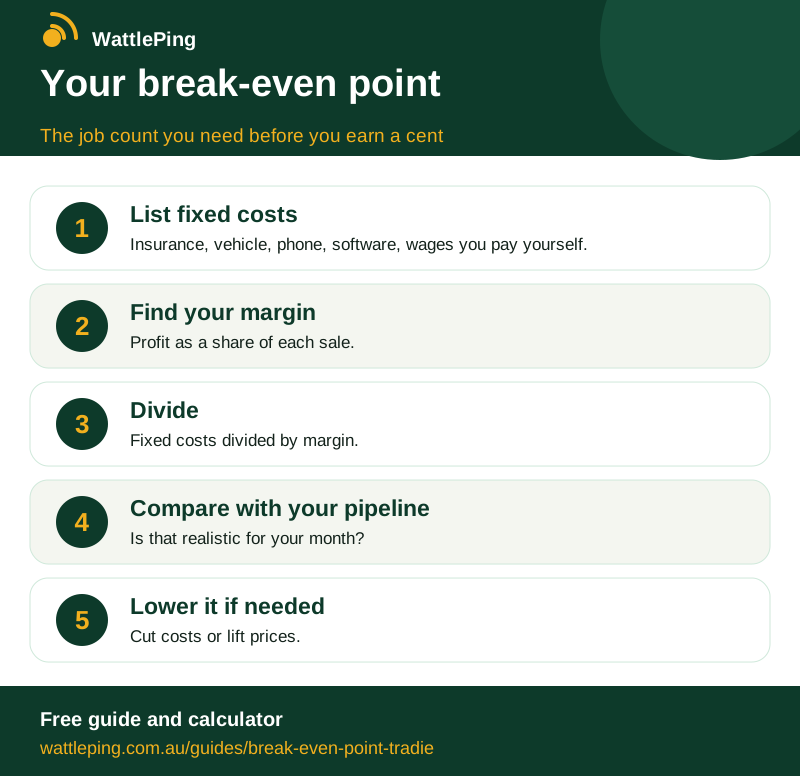
Free to share with a link back. Copy the code below to embed it on your site.
CopiedKeep reading
More in Running the business: Job costing: did that job actually make money? · A weekly admin routine that takes under an hour · How to choose quoting and invoicing software for your trade · Paying super for your employees, simply explained · Starting a trade business in Australia: the setup checklist. All guides, WattlePing features, pricing.