Paying super for your employees, simply explained
If you employ staff, you generally pay super at the super guarantee rate of 12 percent of their ordinary time earnings, at least quarterly, by the due date. Sole traders do not have to pay themselves super, but employees (and some contractors) must be paid it. Check the ATO for your situation.
If you have employees, you generally must pay super on top of their wages. The rate is 12%, and the payment has a firm deadline.
- The rate is 12% of ordinary time earnings.
- Generally due within 28 days of quarter end.
- Check whether contractors count as employees.
The rate
The super guarantee rate is 12% of an employee's ordinary time earnings. It is paid on top of wages, not taken out of them.
Work it out
Super guarantee calculator
Super an employer must pay on an employee's ordinary time earnings at the 12% rate.
- Super per week
- Super per quarter
- Super per year
General guide only. Check your own numbers and, for tax, ask your accountant.
When it is due
Super is generally due within 28 days of the end of each quarter. Paying late means extra charges, so many employers pay more often.
Who counts as an employee
Whether someone is an employee or a contractor depends on the real working arrangement, not the label you give it. Some contractors paid mainly for labour can also count as employees for super. Check the ATO's guidance.
Tip. Use a payroll tool or accountant so the numbers are right each time.
A worked example
An employee earns $1,500 a week in ordinary time earnings. Super at 12% is $180 a week, which is $2,340 a quarter. That is paid on top of their wages.
Keep it simple
- Pay into the employee's chosen super fund.
- Pay each quarter at the latest, or more often if that keeps cash flow smoother.
- Keep records of what you paid and when.
- Check whether any contractors you use count as employees for super.
A worked example
| Quarter | Months | Generally due |
|---|---|---|
| 1 | July to September | 28 October |
| 2 | October to December | 28 January |
| 3 | January to March | 28 April |
| 4 | April to June | 28 July |
Employee ordinary time earnings for the quarter: $15,000. Super at 12%: $1,800.
This is paid on top of the wages, not taken out of them, and must reach the fund by the due date.
Who is an employee for super?
- Full-time, part-time and casual employees are generally covered.
- Some contractors paid mainly for their labour may be treated as employees for super purposes.
- Apprentices and trainees are generally covered.
- Directors who are employees are covered.
Watch out. Getting worker classification wrong can be costly. If you are unsure whether someone is an employee or a contractor, ask your accountant or the ATO.
Keep it simple
- Use a clearing house or payroll softwareTo pay many funds at once.
- Pay a little each pay runSmaller regular payments are easier on cash flow.
- Record each paymentDate, amount and employee.
- Reconcile each quarterBefore the due date.
- Pay earlyA buffer for processing delays.
Mistakes with super
- Paying late and missing the deduction.
- Calculating super on the wrong earnings.
- Forgetting casual staff and apprentices.
- Mixing up contractors and employees.
- Not keeping proof of payment.
A real-life scenario
A small electrical business paid its two employees every fortnight but left super until the quarter ended. The first time cash was tight, the super bill was a shock. The owner switched to paying super with every pay run through a clearing house, which spread the cost and left a record for each payment. By the due date, nothing was outstanding.
Small regular payments are easier on cash flow than one big one.
Quick answers
Do I pay super for apprentices?
Generally yes, if they are employees. Check the ATO's rules.
Do I pay super for myself?
Sole traders are not required to, but you may choose to contribute.
What is the super guarantee rate?
12 percent of ordinary time earnings from 1 July 2025.
When do I have to pay super?
At least quarterly, generally by 28 days after the quarter ends. Check the ATO for exact dates.
Do sole traders pay themselves super?
Not required, but saving for retirement is wise. Ask your accountant about contributions.
What happens if I pay late?
You may owe extra charges and the payment may not be deductible. Pay on time and talk to the ATO if you are struggling.
Share this infographic
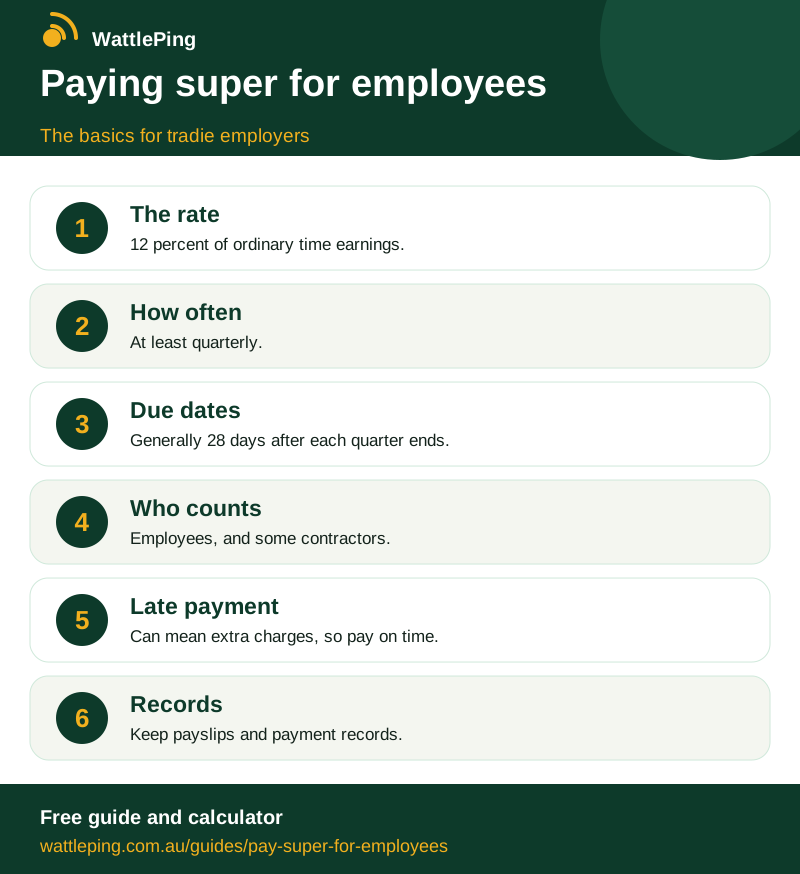
Free to share with a link back. Copy the code below to embed it on your site.
CopiedSources and further reading
This guide is general information, not legal, tax or financial advice. Rules change and differ by state, so check with the ATO, your state regulator or your accountant before you act.
Keep reading
More in Running the business: Job costing: did that job actually make money? · How many jobs do you need to break even? · A weekly admin routine that takes under an hour · How to choose quoting and invoicing software for your trade · Starting a trade business in Australia: the setup checklist. All guides, WattlePing features, pricing.