Guides / Invoicing and getting paid
Payment terms that actually get you paid
Payment terms say when and how a customer must pay. For most tradie jobs, 7 to 14 days from the invoice date is common, with a deposit up front on larger jobs. Write the terms on the quote and the invoice so there is never any doubt.
'Payment on completion' is not a term, it is a hope. Clear terms, agreed before work starts, are the cheapest way to get paid on time.
- Agree terms before work starts.
- Put them on the quote and the invoice.
- Use the same terms for every customer.
What good terms cover
- When payment is due (a date or number of days).
- Deposit and progress payments, if any.
- How the customer can pay.
- What happens if payment is late.
- Who owns the materials until paid, if relevant to your trade.
Choosing the days
Seven or fourteen days suit most residential jobs. Commercial customers often ask for 30 days or more, so build that into your pricing and cash plan.
Work out a due date
Payment due date calculator
Work out the due date from the invoice date and your payment terms.
- Payment due
- Status today
General guide only. Check your own numbers and, for tax, ask your accountant.
Put terms where customers will see them
Put the terms on the quote and again on the invoice, in plain words. Ask the customer to accept the quote, which also means they accepted the terms.
Tip. Short beats legal. Three clear lines are read, three paragraphs are skipped.
Late fees
You can include a late fee or interest, but it must be agreed in advance and be reasonable. Get advice on wording.
Example wording
'Payment is due within 7 days of the invoice date. A 10% deposit is due to confirm your booking. Unpaid invoices may incur a late fee of $X after 14 days.' Replace the numbers with your own and have a professional check the late fee wording.
Be consistent
Use the same terms for every customer. Consistency is fairer, easier to explain and easier to enforce.
Choosing terms for different customers
| Customer | Common terms | Notes |
|---|---|---|
| Homeowner, small job | Due on completion or 7 days | Easy to pay with a link. |
| Homeowner, larger job | Deposit plus staged payments | Protects your materials. |
| Landlord or agent | 7 to 14 days | Confirm who pays at the start. |
| Builder or head contractor | 14 to 30 days, often on a claim schedule | Agree in writing before starting. |
| Business customer | 14 to 30 days | Ask for a PO number if needed. |
Example wording
'Payment terms: 30% deposit on acceptance. Balance due within 7 days of invoice date. Pay by bank transfer to [details] or by card using the link on the invoice.'
'A late fee of [amount or rate] may apply to invoices unpaid 14 days after the due date.' Check with your accountant or lawyer that this is reasonable and allowed for your type of work.
Make terms stick
- Agree before the jobPut terms on the quote.
- Repeat on the invoiceSame wording, same days.
- Make paying one clickPayment link or clear bank details.
- Send remindersOn a schedule.
- Be consistentTreat every customer the same way.
- Review once a yearShorten terms if cash flow is tight.
Cash flow check
If most of your customers pay in 30 days but your suppliers want payment in 7, you are funding your customers' jobs. Shorter terms, deposits and staged payments close that gap. Work out how many days of costs you carry before you are paid, and compare to your terms.
Payment due date calculator
Work out the due date from the invoice date and your payment terms.
- Payment due
- Status today
General guide only. Check your own numbers and, for tax, ask your accountant.
Mistakes with payment terms
- Changing terms from customer to customer with no reason.
- Burying terms in small print on the last page.
- Quoting 30-day terms to a customer who would pay in 7 if asked.
- Adding late fees that were never agreed.
- Not saying who is responsible for paying when there is an agent or owner.
A real-life scenario
A carpenter was paid on a 30-day cycle by a builder, but his timber supplier wanted payment in 14. Every job he did meant two weeks of paying his own money. He moved to a deposit on acceptance, a progress payment at lock-up and 7-day terms on the final invoice for private customers, and negotiated 14 days with the builder. His cash flow steadied without losing any customers.
Terms are a pricing decision, not just paperwork.
Quick answers
What is a normal payment term for residential work?
Many tradies use due on completion or within seven days.
Do I need written terms?
It is much safer to have them. A dispute without written terms is your word against theirs.
What payment terms should I use?
Seven to fourteen days is common for tradies. Use deposits and staged payments on larger jobs.
Do payment terms have to be on the quote?
They do not have to be, but it is the best place to set them. Customers are more likely to accept terms they saw before the job.
Can I offer early payment discounts?
You can, but check that it works for your margins first.
What is the difference between payment terms and a due date?
Terms are the rule, for example 'within 7 days'. The due date is the actual date on a specific invoice.
Share this infographic
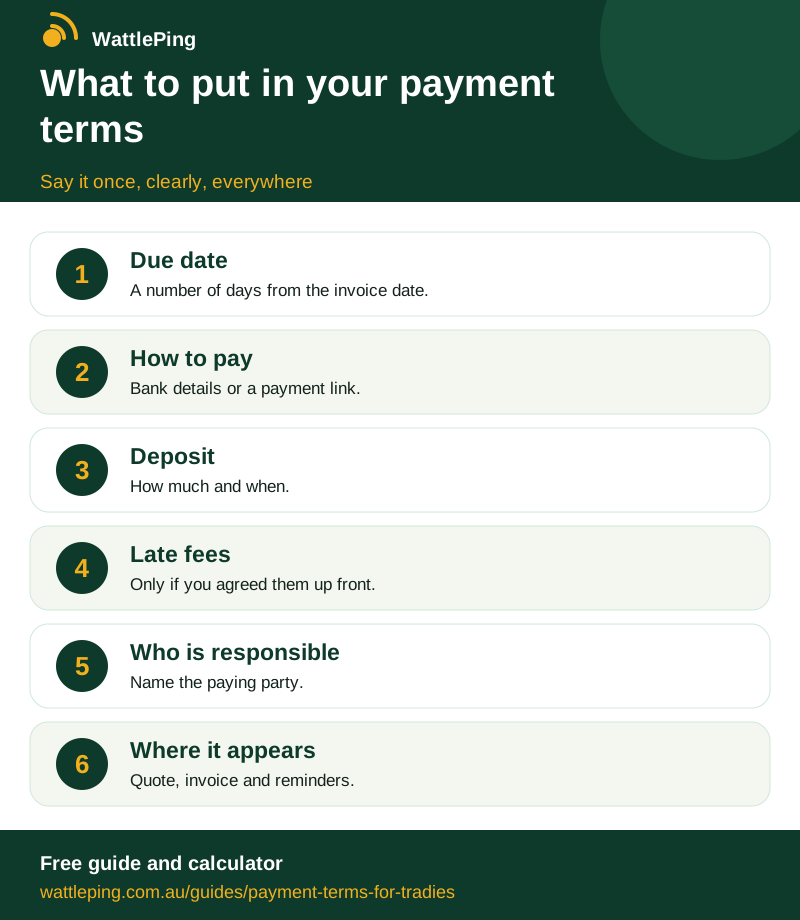
Free to share with a link back. Copy the code below to embed it on your site.
CopiedSources and further reading
This guide is general information, not legal, tax or financial advice. Rules change and differ by state, so check with the ATO, your state regulator or your accountant before you act.
Keep reading
More in Invoicing and getting paid: How to write a valid tax invoice in Australia (with a free checklist) · How to chase an overdue invoice without losing the customer · How to ask for a deposit on a trade job · Progress payments: get paid as the job moves along · How to get paid faster as a tradie: 12 things that work. All guides, WattlePing features, pricing.