Guides / Invoicing and getting paid
How to chase an overdue invoice without losing the customer
Chase an overdue invoice with a calm, written ladder: a friendly reminder on the due date, a follow-up a few days later, a firmer notice at about ten days, and a final notice or letter of demand at three weeks. Keep every message factual, and get advice before taking legal steps.
Chasing money feels awkward, so many tradies put it off. That delay is expensive. A simple, consistent routine gets most invoices paid without a fight.
- Send the invoice the day the job ends.
- Remind on the due date, not a week later.
- Keep every message as a paper trail.
Start before it is late
Send the invoice as soon as the job is done and say clearly when it is due. Most late payments begin with a slow invoice.
A simple chasing ladder
- The day it is due: a friendly reminder with the payment details again.
- 3 to 7 days late: a short message asking if there is a problem.
- 14 days late: a firmer message that names the amount and a date you expect payment.
- 21 or more days late: a formal letter of demand, and consider advice on next steps.
Make it easy for them to pay
Put your bank details or a payment link in every reminder. Customers who forget are often one tap away from paying.
Check where the invoice stands
Work out the due date and see how many days late it is.
Payment due date calculator
Work out the due date from the invoice date and your payment terms.
- Payment due
- Status today
General guide only. Check your own numbers and, for tax, ask your accountant.
Be firm, not rude
Stay factual: the job, the amount, the date. Avoid threats you will not follow through on. If someone disputes the work, listen first. Many disputes are about a misunderstanding that can be fixed.
Tip. Keep a record of every message. If a debt ever goes further, a tidy paper trail matters.
When to get help
For large debts, building work or disputes, speak to your industry body, a small business advisory service or a lawyer. Rules for security of payment differ across states.
Messages you can copy
'Hi [Name], a quick reminder that invoice [number] for [amount] is due today. You can pay using the link below. Thanks, [You].'
'Hi [Name], invoice [number] for [amount] was due on [date] and is now 10 days overdue. Please pay by [date] or let me know if there is a problem. Payment details are below.'
'Hi [Name], this is a final notice for invoice [number], [amount], now 21 days overdue. If I do not receive payment by [date] I will need to consider further steps. I would prefer to resolve this directly.'
Why people pay late
- They did not receive the invoice or it went to spam.
- The invoice was unclear or did not match the quote.
- They are waiting on their own money.
- They forgot, which is more common than anything else.
- They are disputing the work, which needs a conversation, not a reminder.
Watch out. Do not threaten, harass or contact people at odd hours. Keep every message calm and professional.
A weekly chasing habit
- List unpaid invoicesPull up everything overdue.
- Sort by age and amountChase the largest and oldest first.
- Send the next message in the ladderDo not skip steps.
- Phone if it is largeA call can unlock a payment.
- Record every contactDate, method and reply.
- Escalate when dueFinal notice, then advice on a letter of demand.
When to get help
If a customer ignores a final notice, you have options such as a formal letter of demand or applying through the relevant small claims or tribunal process. The right path depends on your state, the amount and the type of work, so speak with a lawyer, your industry body or the relevant state regulator first. Keep copies of the quote, invoice, messages and photos of the finished work.
Mistakes that make chasing harder
- Waiting until the invoice is a month old before saying anything.
- Chasing by phone only, with nothing in writing.
- Getting angry. Calm persistence works better.
- Letting a good customer slide, which teaches others they can too.
- Not keeping the quote, invoice and messages together.
A real-life scenario
An electrician had $9,800 outstanding across six invoices. He started a Friday routine: list everything overdue, send the next message in the ladder, phone the two largest. Within a fortnight four invoices were paid, one customer explained a banking mix-up and one needed a payment plan, which he agreed in writing. Most of the money was recovered with plain, regular follow-up.
Doing it weekly is what made the difference, not clever wording.
Quick answers
Can I charge interest on late invoices?
Only if you agreed to it up front in your terms. Put late fees in your quote and invoice.
Should I stop work if a customer owes me?
For staged jobs, many tradies pause until the last stage is paid. State it in your terms before you start.
How long should I wait before chasing?
Send a reminder on or just before the due date. Waiting a week makes the invoice easier to ignore.
Can I charge interest on late invoices?
Only if you agreed it in advance. Check with your lawyer or accountant before adding fees.
What is a letter of demand?
A formal written request for payment by a set date, often a step before legal action. Get advice before sending one.
Should I stop work on unpaid jobs?
On staged jobs you may be able to pause if a progress payment is overdue, depending on your contract. Check your agreement.
Share this infographic
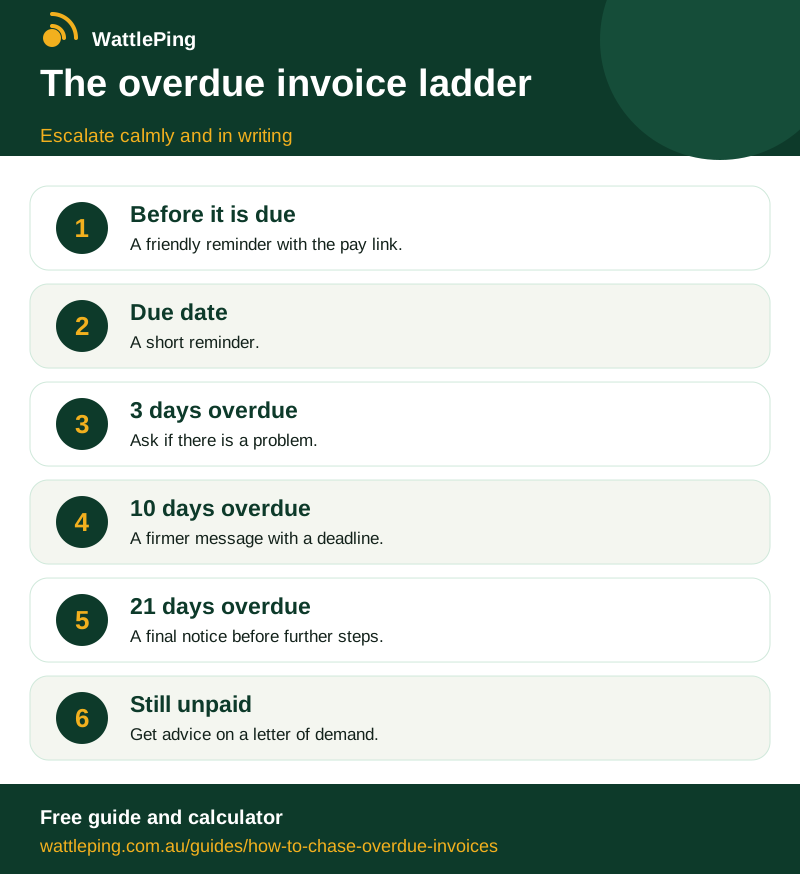
Free to share with a link back. Copy the code below to embed it on your site.
CopiedSources and further reading
This guide is general information, not legal, tax or financial advice. Rules change and differ by state, so check with the ATO, your state regulator or your accountant before you act.
Keep reading
More in Invoicing and getting paid: How to write a valid tax invoice in Australia (with a free checklist) · Payment terms that actually get you paid · How to ask for a deposit on a trade job · Progress payments: get paid as the job moves along · How to get paid faster as a tradie: 12 things that work. All guides, WattlePing features, pricing.