Quote or estimate? Why the word matters
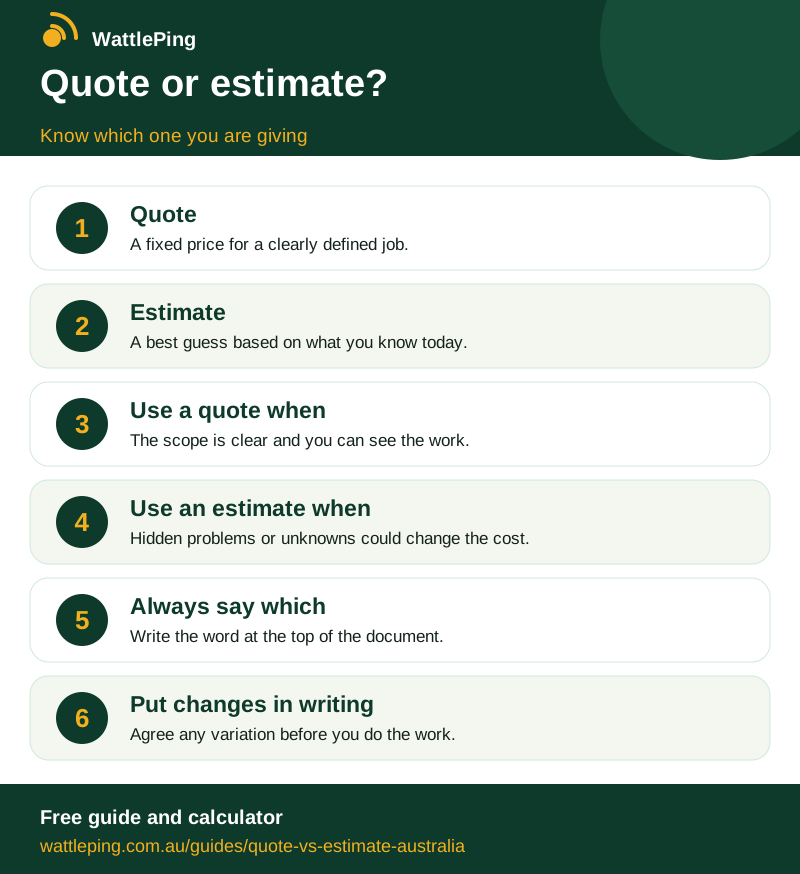
A quote is a fixed price for defined work. An estimate is a best guess that can change. Use a quote when the scope is clear and an estimate when you cannot know the cost yet. Say clearly which you are giving, because the difference can matter legally and for customer trust.
Customers often use the words as if they mean the same thing. They do not, and mixing them up is a common cause of disputes about the final bill. Here is how to use each.
- A quote is a fixed price, an estimate is a guess.
- Use estimates when there are real unknowns.
- Put variations in writing before you do them.
What each one means
A quote is a fixed price for a defined job. If you quote $2,000, that is what the customer expects to pay unless the scope changes. An estimate is your best guess, and the final price can move as the work becomes clear.
When to quote and when to estimate
- Quote when the scope is clear and you can see the work.
- Estimate when the work is unknown, such as hidden damage, old wiring or ground conditions.
- Whenever the job has a big unknown, say so in writing.
Protect yourself either way
Whichever you give, state what it covers, what it does not, and how extra work will be priced. Include how long the price is valid.
Quote checklist
0 of 9 done. Your ticks stay on this device.
Rules differ by state
Some states have specific rules for building work, including written contracts above certain values and limits on how far a final price can exceed an estimate. Check your state regulator or fair trading office for the rules that apply to your trade.
Tip. If you are unsure, call your state's fair trading office. It is free and quicker than a dispute.
Example wording
For a quote: 'Fixed price of $3,200 including GST, valid for 30 days, for the work listed above.' For an estimate: 'Estimated at $2,800 to $3,500 including GST, to be confirmed once the existing wiring has been inspected.'
Quote and estimate side by side
| Quote | Estimate | |
|---|---|---|
| Price | Fixed | Approximate, can change |
| Risk | Mostly on you | Shared with the customer |
| Best when | Scope is clear | Scope has unknowns |
| Customer expectation | That is the price | That is roughly the price |
| Wording | 'Fixed price quote' | 'Estimate only, subject to change' |
Choosing for different jobs
- Replacing a tap or fitting a light: a quote works, the work is known.
- Renovating an old bathroom: an estimate with a clear process for extras, or a quote with a contingency.
- Fault finding: an hourly rate or an estimate until the problem is found.
- New build or extension: a detailed quote against plans and a written contract.
- Emergency work: a call-out fee plus an hourly rate.
Tip. If you give an estimate, say what could make it go up. It protects you and sets expectations.
How to word it
'Fixed price quote: $1,850 including GST for supply and installation of [item] at [address], valid for 30 days. Excludes [list]. Any extra work will be quoted and agreed before it starts.'
'Estimate only: approximately $2,400 to $3,200 including GST, depending on what is found behind the existing wall. We will contact you before any work that would exceed this range.'
Avoid disputes
Consumer law, licensing rules and cost-estimate rules can differ by state and by type of work, so check with your state regulator or industry body for your trade.
- State which one you are givingWrite 'Quote' or 'Estimate' at the top.
- List what is and is not includedExclusions prevent most arguments.
- Say what could change the priceHidden damage, access issues or customer changes.
- Agree variations in writingA short text or email is fine.
- Keep the paper trailStore quotes, messages and photos together.
Mistakes that cause disputes
- Calling a rough guess a quote, then being held to it.
- Calling a firm price an estimate, then losing customers who wanted certainty.
- Leaving out the exclusions, so the customer assumes everything is covered.
- Agreeing extras by word of mouth and then arguing about the bill.
- Not saying how long the price is valid.
A real-life scenario
A bathroom renovation quoted at a fixed $11,000 ran into rotten framing behind the shower wall. Because the quote stated that concealed damage was excluded and would be priced separately, the tradie sent a photo, a price for the repair and a short variation, which the customer approved the same day. Without that line, the choice would have been to wear the cost or argue.
The lesson is the same for every job: the document is only as good as the assumptions written on it.
Quick answers
Can I charge more than my quote?
Only for agreed extra work. Put variations in writing before you do them.
Is an estimate binding?
Not in the same way as a quote, but rules differ by state and trade. Check your regulator.
Can I charge more than an estimate?
Rules differ by state and by trade. Many places expect you to stay close to an estimate or get the customer's agreement first. Check your state regulator.
Is a quote legally binding?
A quote that is accepted can form part of a contract. Get advice if you are unsure about a specific job.
Should a quote say 'estimate'?
Only if it is genuinely an estimate. Using the right word protects you and avoids confusion.
How long should a quote stay valid?
Commonly 14 to 30 days. Say so on the quote.
Share this infographic
Free to share with a link back. Copy the code below to embed it on your site.
CopiedSources and further reading
This guide is general information, not legal, tax or financial advice. Rules change and differ by state, so check with the ATO, your state regulator or your accountant before you act.
Keep reading
More in Quoting and pricing: How to quote a job: a step-by-step guide for tradies · How to calculate your hourly rate as a tradie · Markup vs margin: the difference that decides your profit · How to follow up a quote without sounding pushy · Seven reasons customers say nothing after your quote. All guides, WattlePing features, pricing.