How to follow up a quote without sounding pushy
Follow up a quote two days after sending it, with a short friendly message that offers help instead of pressure. Send a second nudge about five days later and a final one around day ten. Most quotes that stall are not rejections, they are forgotten.
A lot of quotes go quiet because the customer got busy, not because they said no. A short, friendly follow-up turns many of them into jobs. Here is when to send it and what to say.
- Follow up on day 2, day 5 and day 10.
- Keep it short and ask one easy question.
- Send quotes the same day you visit.
When to follow up
- Day 2: a quick check that the quote arrived and made sense.
- Day 5: ask if they have any questions, and mention your availability.
- Day 10: a final, easy-to-answer message. After that, let it go politely.
Follow-ups win work
Most replies come after a nudge, not the first send.
Illustrative split to show the idea, not a measured statistic.
Write your message
Fill in the details and copy the text.
Quote follow-up message writer
A polite follow-up you can copy and send by text or email.
- Message
Copied
General guide only. Check your own numbers and, for tax, ask your accountant.
What makes a follow-up work
- It is short enough to read on a lock screen.
- It asks one easy question, not three.
- It offers help (a call, a change to the scope) instead of pressure.
- It sounds like you.
Why speed matters
Customers often ask two or three businesses for a price. The one who replies first and follows up politely usually looks the most organised, which is a reason to hire them.
Tip. Send the quote the same day you visit. Every day you wait gives another business a chance.
Let software do the nagging
Remembering to chase every quote is hard when you are on the tools. Tools like WattlePing can remind customers about unaccepted quotes automatically so you do not have to.
A follow-up schedule that works
The goal is to be helpful, not pushy. A short schedule means you never have to decide how awkward you feel each time.
| When | Purpose | Example opener |
|---|---|---|
| Day 2 | Check it arrived | Hi Sam, just checking the quote for the deck came through okay. |
| Day 5 | Add something useful | I have a gap on the 18th if you'd like to lock it in. |
| Day 10 | Close the loop | I'll hold this price until Friday. No worries either way. |
| Day 30 | Light touch | Still thinking about the job? Happy to refresh the quote. |
Templates you can copy
Hi [Name], it's [You] from [Business]. Just checking the quote for [job] reached you okay. Happy to answer any questions or adjust anything. Cheers.
Hi [Name], I've got a gap on [date] if you'd like to get [job] booked in. Let me know if you'd like me to hold it for you.
Hi [Name], I'll keep your quote for [job] open until [date], then free up the spot. If the timing isn't right, no problem at all. Thanks for considering us.
Why customers go quiet
A good follow-up handles each of these without pressure. It reminds, it makes a decision easy and it leaves the door open.
- They got busy and forgot, which is the most common reason.
- They are waiting on other quotes and comparing.
- They are unsure about price but do not like saying so.
- The quote was hard to read or unclear on what is included.
- They have decided to delay the job.
Tip. If someone says the price is too high, ask what they were expecting. You may be able to adjust the scope instead of the rate.
Which channel to use
| Channel | Best for | Watch out for |
|---|---|---|
| Text message | Homeowners and small jobs | Keep it short and polite. |
| Bigger jobs and businesses | Easy to bury, so keep the subject clear. | |
| Phone call | Jobs worth chasing hard | Call at a sensible hour and leave a message. |
| Whichever they used first | Everything | Matching their channel gets faster replies. |
Mistakes that make follow-ups backfire
- Sending three messages in one day. Space them out.
- Opening with 'Just checking in' and nothing else. Offer something useful.
- Dropping your price in the first follow-up. It teaches customers to wait.
- Sounding annoyed. Customers can hear it even in text.
- Following up after they said no. Thank them and leave the door open.
A real-life scenario
Jo quoted a $4,200 fence on Monday. By Wednesday there was no reply, so she sent a two-line text asking if the quote had come through and offering a start date in two weeks. The customer replied within the hour: they had been away and meant to reply. The job was booked by Thursday. Most follow-ups work like that, not because the customer needed persuading, but because they needed a nudge and a clear next step.
Keep a simple list of open quotes with the date sent and the date you next follow up. Review it during your weekly admin hour, and clear anything older than a month with one last courteous message.
Quick answers
How many times should I follow up?
Two or three polite messages across ten days is plenty.
Should I call or text?
Text or email first, since it is less intrusive. Call if the job is large and they have gone quiet.
How many times should I follow up a quote?
Two or three times over about ten days is plenty for most jobs, then a light check-in after a month.
Is following up annoying?
Not when it is short and helpful. Most customers appreciate a reminder because they are busy.
Should I follow up by text or email?
Use the same channel the customer used. Text works well for homeowners, email for larger jobs.
What if they say the quote is too expensive?
Ask what they were expecting and whether the scope can change. Avoid cutting your rate straight away.
Share this infographic
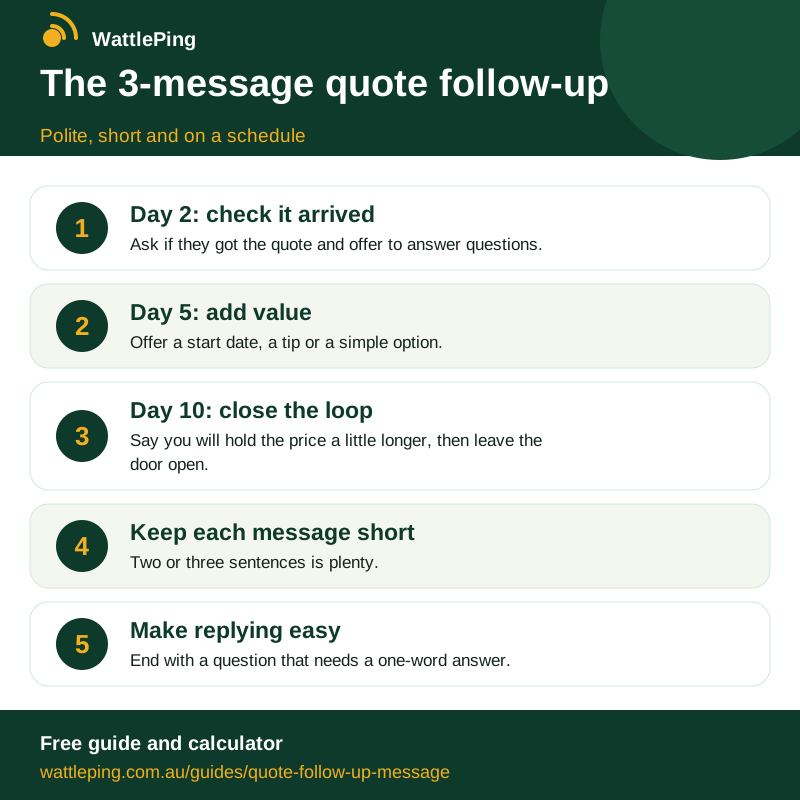
Free to share with a link back. Copy the code below to embed it on your site.
CopiedKeep reading
More in Quoting and pricing: How to quote a job: a step-by-step guide for tradies · How to calculate your hourly rate as a tradie · Markup vs margin: the difference that decides your profit · Quote or estimate? Why the word matters · Seven reasons customers say nothing after your quote. All guides, WattlePing features, pricing.