Seven reasons customers say nothing after your quote
Customers most often do not accept a quote because it arrived late, was unclear, felt expensive without showing value, lacked trust signals or was simply forgotten. Fix speed, clarity, proof and follow-up before you cut your price.
Silence after a quote is rarely a polite no. It is usually friction. Here are the common causes and what to do about each.
- Speed and clarity beat the cheapest price.
- Make accepting a quote one tap.
- Most silence is forgetfulness, so follow up.
The seven reasons
- You were slow. Another business replied first.
- The quote was hard to read. A messy PDF or a text with no breakdown looks risky.
- It was hard to accept. If they have to print, sign and scan, many will not bother.
- The price felt unexplained. A single number invites comparison. A clear breakdown builds trust.
- They were not sure of the next step. Say when you can start and what happens on acceptance.
- They forgot. Life gets busy. This is the most common one.
- They found someone cheaper. Sometimes true, and sometimes fine to lose.
Fix the first six
- Reply to enquiries fast (see answering enquiries faster).
- Send a clean, branded quote.
- Let customers accept with one tap.
- Show what the price includes.
- End the quote with a clear next step.
- Follow up kindly (see the follow-up guide).
Check your quote
Quote checklist
0 of 9 done. Your ticks stay on this device.
Do not race to the bottom
Competing only on price is a losing game. Compete on speed, clarity and trust, and be comfortable losing jobs that would not have paid well.
Which problem do you have?
| Sign | Likely cause | Fix |
|---|---|---|
| Customers never reply | Late, unclear or forgotten quote | Send faster and follow up. |
| They reply 'too expensive' | Value not shown | Itemise or explain what is included. |
| They go with a cheaper tradie | Price-led comparison | Show your reviews, warranty and speed. |
| They say they will think about it | Unsure or comparing | Offer a short deadline or a booking slot. |
| They ask lots of questions | Interested but uncertain | Answer fast and clearly. |
Make your quote easier to say yes to
- Send within hoursThe first good quote often wins.
- Open with the resultDescribe what they get, not just what you do.
- Add proofInclude a line about reviews, licence and insurance.
- Offer optionsA basic and a better option often lifts acceptance.
- Make accepting easyA reply, a link or a tap.
- Follow up politelySee our follow-up message guide.
Track your win rate
If you do not know how many quotes you win, you cannot improve it. Count quotes sent and quotes accepted over a month. Many tradies win between a quarter and a half of the quotes they send. If you are winning almost every quote, you are probably too cheap. If you are winning very few, look at speed and clarity first, then price.
Quotes sent this month: 20. Accepted: 7. Win rate: 35%.
If your average job is $2,000, each extra quote you win is worth $2,000. Improving your win rate by 5 percentage points means one more job a month.
Questions to ask a customer who says no
You will not win them all, but a polite question after a lost quote is the cheapest market research you can do. Write down the answers and look for patterns over a few months.
- 'Was there anything in the quote that wasn't clear?'
- 'Did you go with someone else, and if so what made the difference?'
- 'Is the timing the problem, or the price?'
- 'Would a smaller scope or staged approach suit you better?'
A real-life scenario
A painter was winning about one in five quotes. Reading back his quotes, he saw they were a single line with a total and no description. He rewrote the template to list the rooms, the prep, the paint brand and the clean-up, added three recent reviews and a start date, and began sending quotes the same day. His win rate lifted within two months, without lowering his price.
Clarity, proof and speed usually do more for acceptance than a discount.
Quick answers
How many quotes should turn into jobs?
It varies hugely by trade, so track your own number and aim to improve it.
Should I drop my price if they go quiet?
Usually no. Offer to adjust the scope instead.
What is a good quote acceptance rate?
It varies by trade and market. Many tradies win roughly a quarter to a half. Track yours and aim to improve it.
Should I drop my price if customers say no?
Not first. Check speed, clarity and proof before cutting price.
How fast should I send a quote?
The same day if you can. Speed is one of the strongest signals of reliability.
Do reviews help win quotes?
Yes. Customers often check reviews before accepting, so show them on the quote.
Share this infographic
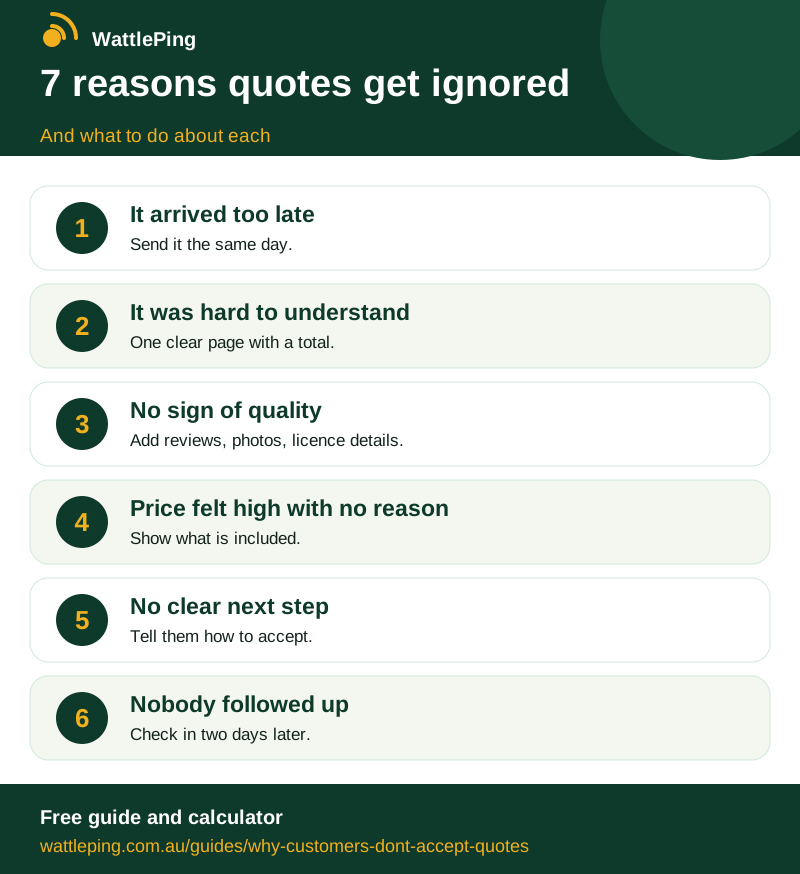
Free to share with a link back. Copy the code below to embed it on your site.
CopiedKeep reading
More in Quoting and pricing: How to quote a job: a step-by-step guide for tradies · How to calculate your hourly rate as a tradie · Markup vs margin: the difference that decides your profit · How to follow up a quote without sounding pushy · Quote or estimate? Why the word matters. All guides, WattlePing features, pricing.